
Set Demonstration
Loading the math board and drawing, please wait…
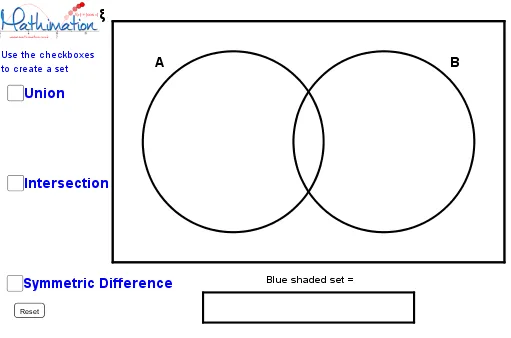
This example dynamically visualizes set operations like intersections and unions, illustrating the geometric meaning of set theory. It involves core concepts including set theory, similarity transformation, congruence, orthocenter, and logic. GeoGebra commands used in construction include Polygon, Circle, Intersect, and CircleArc. Suitable for high school mathematics teaching to help students understand abstract set operations and geometric transformations.
GeoGebra Commands & Parameters
Polygon(A_1, B_1, C, D) → Back, a_2, b_2, c_2, d_2Polygon(E, F, G, H) → Backblue, e_3, f_3, g_3, h_3Polygon(I, J, K, L) → OutlneBox, i, j, k, lCircle(M, N) → A'Circle(O, P) → B'Circle(Q, R) → ACircle(S, T) → BCircle(U, V) → OutlineACircle(W, Z) → OutlineBCircle(Q_1, R_1) → A_2Circle(S_1, T_1) → B_2Polygon(E_1, F_1, G_1, H_1) → Backblue_1, e_1, f_1, g_1, h_1Circle(M_1, N_1) → A'_1Circle(O_1, P_1) → B'_1Circle(C_1, D_1) → pCircle(I_1, J_1) → qIntersect(p, q, 2) → K_1Intersect(p, q, 1) → L_1CircleArc(C_1, K_1, L_1) → Intersect1CircleArc(I_1, L_1, K_1) → Intersect2Circle(C_2, D_2) → p_1Circle(I_2, J_2) → q_1Intersect(p_1, q_1, 2) → K_2Intersect(p_1, q_1, 1) → L_2CircleArc(C_2, K_2, L_2) → Intersect1_1CircleArc(I_2, L_2, K_2) → Intersect2_1Polygon(A_3, B_3, C_3, D_3) → Back_1, a_1, b_1, c_1, d_1Polygon(E_2, F_2, G_2, H_2) → Backblue_2, e_2, f_2, g_2, h_2Circle(S_3, T_3) → B_4Circle(Q_3, R_3) → A_4Circle(C_4, D_4) → p_3Circle(I_3, J_3) → q_2Intersect(p_3, q_2, 2) → K_3Intersect(p_3, q_2, 1) → L_3CircleArc(C_4, K_3, L_3) → Intersect1_2CircleArc(I_3, L_3, K_3) → Intersect2_2Circle(C_5, D_5) → p_4Circle(I_4, J_4) → q_3Intersect(p_4, q_3, 2) → K_4Intersect(p_4, q_3, 1) → L_4CircleArc(C_5, K_4, L_4) → Intersect1_3CircleArc(I_4, L_4, K_4) → Intersect2_3Circle(C_6, D_6) → p_5Circle(I_5, J_5) → q_4Intersect(p_5, q_4, 2) → K_5Intersect(p_5, q_4, 1) → L_5CircleArc(C_6, K_5, L_5) → Intersect1_4CircleArc(I_5, L_5, K_5) → Intersect2_4Circle(C_7, D_7) → p_6Circle(I_6, J_6) → q_5Intersect(p_6, q_5, 2) → K_6Intersect(p_6, q_5, 1) → L_6CircleArc(C_7, K_6, L_6) → Intersect1_5CircleArc(I_6, L_6, K_6) → Intersect2_5Circle(Q_4, R_4) → A_5Circle(S_4, T_4) → B_5Circle(M_3, N_3) → A'_2Polygon(A_6, B_6, C_{13}, D_{13}) → Back_2, a_3, b_3, c_3, d_3Polygon(E_3, F_3, G_3, H_3) → Backblue_3, e_4, f_4, g_4, h_4Circle(O_3, P_3) → B'_2Polygon(A_8, B_8, C_{15}, D_{15}) → Back_4, a_5, b_5, c_5, d_5Polygon(A_9, B_9, C_{16}, D_{16}) → Back_3, a_4, b_4, c_4, d_4Polygon(E_4, F_4, G_4, H_4) → Backblue_4, e_5, f_5, g_5, h_5Circle(C_{18}, D_{18}) → p_7Circle(I_7, J_7) → q_6Intersect(p_7, q_6, 2) → K_7Intersect(p_7, q_6, 1) → L_7CircleArc(C_{18}, K_7, L_7) → Intersect1_6CircleArc(I_7, L_7, K_7) → Intersect2_6Circle(C_{19}, D_{19}) → p_8Circle(I_8, J_8) → q_7Intersect(p_8, q_7, 2) → K_8Intersect(p_8, q_7, 1) → L_8CircleArc(C_{19}, K_8, L_8) → Intersect1_7CircleArc(I_8, L_8, K_8) → Intersect2_7Polygon(A_{11}, B_{11}, C_{20}, D_{20}) → Back_5, a_6, b_6, c_6, d_6Polygon(E_6, F_6, G_6, H_6) → Backblue_5, e_6, f_6, g_6, h_6Circle(C_{24}, D_{24}) → p_9Circle(I_9, J_9) → q_8Intersect(p_9, q_8, 2) → K_9Intersect(p_9, q_8, 1) → L_9Circle(C_{25}, D_{25}) → p_{10}Circle(I_{10}, J_{10}) → q_9Intersect(p_{10}, q_9, 2) → K_{10}Intersect(p_{10}, q_9, 1) → L_{10}CircleArc(C_{25}, K_{10}, L_{10}) → Intersect1_8CircleArc(I_{10}, L_{10}, K_{10}) → LeftWIntersectionIntersect(OutlineA, OutlineB, 2) → V_2Intersect(OutlineA, OutlineB, 1) → W_2CircleArc(U_2, V_2, W_2) → RightWIntersectionCircle(M_5, N_5) → A'_3Circle(Q_8, R_8) → A_{15}Circle(M_8, N_8) → A'_4Circle(O_4, P_4) → B'_3Circle(C_{34}, D_{34}) → p_{11}Circle(I_{11}, J_{11}) → q_{10}Intersect(p_{11}, q_{10}, 2) → K_{11}Intersect(p_{11}, q_{10}, 1) → L_{11}CircleArc(C_{34}, K_{11}, L_{11}) → Intersect1_9Polygon(A_{16}, B_{15}, C_{42}, D_{42}) → Back_6, a_7, b_7, c_7, d_7Circle(O_5, P_5) → B'_4Circle(S_9, T_9) → B_{20}Circle(O_7, P_7) → B'_5Circle(O_{10}, P_{10}) → B'_6Circle(O_{13}, P_{13}) → B'_7Circle(S_{18}, T_{18}) → B_{21}Circle(M_{12}, N_{12}) → A'_6Circle(M_{13}, N_{13}) → A'_5Circle(Q_{14}, R_{14}) → A_{21}Circle(M_{19}, N_{19}) → A'_7Circle(O_{16}, P_{16}) → B'_8Circle(C_{63}, D_{63}) → p_{12}Circle(I_{51}, J_{51}) → q_{11}Intersect(p_{12}, q_{11}, 2) → K_{12}Intersect(p_{12}, q_{11}, 1) → L_{12}CircleArc(C_{63}, K_{12}, L_{12}) → Intersect1_{10}CircleArc(I_{51}, L_{12}, K_{12}) → LeftWIntersection_2Circle(M_{26}, N_{26}) → A'_9Circle(M_{25}, N_{25}) → A'_8Circle(O_{20}, P_{20}) → B'_9Polygon(E_8, F_8, G_8, H_8) → Backblue_6, e_7, f_7, g_7, h_7Circle(O_{25}, P_{25}) → B'_{10}Circle(M_{37}, N_{37}) → A'_{10}Circle(O_{35}, P_{35}) → B'_{11}Polygon(A_{22}, B_{22}, C_{103}, D_{103}) → Back_7, a_8, b_8, c_8, d_8Polygon(E_9, F_9, G_9, H_9) → Backblue_7, e_8, f_8, g_8, h_8Circle(M_{51}, N_{51}) → A'_{12}Circle(O_{51}, P_{51}) → B'_{13}Circle(M_{52}, N_{52}) → A'_{11}Circle(O_{52}, P_{52}) → B'_{12}Circle(C_{109}, D_{109}) → p_{13}Circle(I_{107}, J_{107}) → q_{12}Intersect(p_{13}, q_{12}, 2) → K_{13}Intersect(p_{13}, q_{12}, 1) → L_{13}CircleArc(C_{109}, K_{13}, L_{13}) → Intersect1_{11}CircleArc(I_{107}, L_{13}, K_{13}) → LeftWIntersection_1Circle(M_{65}, N_{65}) → A'_{15}Circle(M_{66}, N_{66}) → A'_{14}Circle(M_{67}, N_{67}) → A'_{13}Circle(Q_{41}, R_{41}) → A_{28}Circle(S_{48}, T_{48}) → B_{28}Circle(O_{73}, P_{73}) → B'_{14}Circle(M_{92}, N_{92}) → A'_{16}Circle(O_{83}, P_{83}) → B'_{15}Circle(C_{157}, D_{157}) → p_{14}Circle(I_{147}, J_{147}) → q_{13}Intersect(p_{14}, q_{13}, 2) → K_{14}Intersect(p_{14}, q_{13}, 1) → L_{14}CircleArc(C_{157}, K_{14}, L_{14}) → Intersect1_{12}CircleArc(I_{147}, L_{14}, K_{14}) → LeftWIntersection_3Circle(U_{61}, V_{25}) → OutlineA_1Circle(W_{32}, Z_{38}) → OutlineB_1Intersect(OutlineA_1, OutlineB_1, 2) → V_{31}Intersect(OutlineA_1, OutlineB_1, 1) → W_{38}CircleArc(U_{62}, V_{31}, W_{38}) → RightWIntersection_1Circle(M_{103}, N_{103}) → A'_{17}Circle(O_{93}, P_{93}) → B'_{16}Circle(U_{63}, V_{34}) → OutlineA_2Circle(W_{41}, Z_{39}) → OutlineB_2Intersect(OutlineA_2, OutlineB_2, 2) → V_{35}Intersect(OutlineA_2, OutlineB_2, 1) → W_{42}CircleArc(U_{64}, V_{35}, W_{42}) → RightWIntersection_2Circle(M_{115}, N_{115}) → A'_{19}Circle(O_{104}, P_{104}) → B'_{18}Circle(M_{116}, N_{116}) → A'_{18}Circle(O_{105}, P_{105}) → B'_{17}Circle(U_{71}, V_{39}) → OutlineA_3Circle(W_{46}, Z_{43}) → OutlineB_3Intersect(OutlineA_3, OutlineB_3, 2) → V_{40}Intersect(OutlineA_3, OutlineB_3, 1) → W_{47}CircleArc(U_{72}, V_{40}, W_{47}) → RightWIntersection_3Polygon(E_{11}, F_{11}, G_{11}, H_{11}) → poly1, e_{11}, f_{11}, g_{11}, h_{11}Polygon(E_{12}, F_{12}, G_{12}, H_{12}) → poly2, e_{12}, f_{12}, g_{12}, h_{12}Polygon(G_{13}, H_{13}, E_{14}, F_{14}) → poly3, g_{13}, h_{13}, e_{14}, f_{14}Polygon(G_{15}, H_{15}, K_{15}, L_{15}) → poly4, g_{15}, h_{15}, k_{15}, l_{15}
AI Drawing Prompt Reference
Draw two polygons in different colors, then create three circles that intersect with the polygons, connecting the intersection points with arcs to illustrate set operations like intersections and unions, demonstrating geometric transformations including similarity and congruence, suitable for high school mathematics teaching to help students understand abstract set operations and geometric transformations.
The prompt above was compiled from the original drawing commands and is for reference only.