
Pythagorean Theorem Proof by Mathimation
Loading the math board and drawing, please wait…
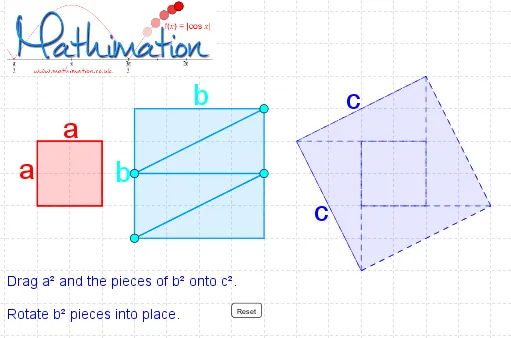
This example dynamically demonstrates the Pythagorean Theorem, illustrating the relationship between the sides of a right triangle. It involves core math concepts like the Pythagorean Theorem, congruence, real numbers, subtraction, and scalene triangles. Construction highlights include using GeoGebra commands Polygon, Point, and Segment to create shapes involving points A, B, C, D, E, F, and polygons poly1, poly2, etc. Suitable for middle school and above, it helps students grasp the visual proof and geometric construction of the theorem.
GeoGebra Commands & Parameters
Polygon(A, B, 4) → poly1, a, b, c, d, C, DPolygon(E, F, 4) → poly2, e, f, g, h, G, HPoint(Circle[B, 4]) → MSegment(B, M) → mPoint(Circle[A, 4]) → NSegment(A, N) → nPoint(Circle[D, 4]) → OSegment(D, O) → pPoint(Circle[C, 4]) → PSegment(C, P) → qSegment(N, O) → rSegment(O, P) → sSegment(P, M) → tSegment(M, N) → a_1Polygon(T, U, V, W) → poly5, t_1, u, v, wPolygon(C_1, D_1, 4) → poly7, c_1, d_1, e_1, f_1, E_1, F_1Point(Circle[Q, 4]) → RPolygon(Q, R, S) → poly4, s_1, q_2, r_1Point(Circle[Z, 4]) → A_1Polygon(Z, A_1, B_1) → poly6, b_1, z, a_2Point(Circle[Q_1, 4]) → R_1Polygon(Q_1, R_1, S_1) → poly4_1, s_2, q_3, r_2Point(Circle[Q_2, 4]) → R_2Polygon(Q_2, R_2, S_2) → poly4_2, s_3, q_4, r_3Polygon(L, G_1, 4) → poly3, i, j, k, l, H_1, I_1