
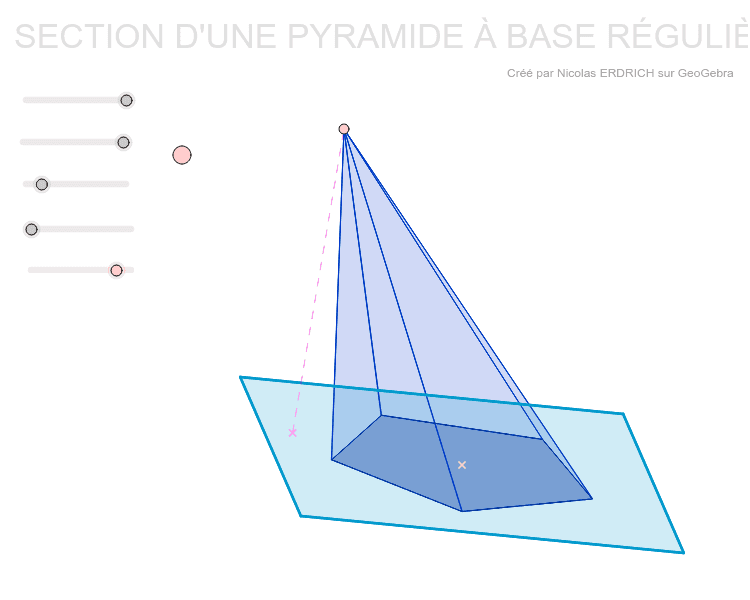
Section of a Regular Polygon Pyramid
Loading the math board and drawing, please wait…
In collections
truncated pyramid
This example demonstrates the cross-section of a regular polygon pyramid cut by a plane parallel to its base. Key math concepts include polygons, solid geometry, similar triangles, and proportionality. Construction highlights the use of commands/objects like Vector, Dilate, Polygon, Translate, PointIn, Segment, and Sequence from GeoGebra. Suitable for high school solid geometry instruction to understand cross-section properties and polygon relationships.
GeoGebra Commands & Parameters
Vector(O, Z) → wVector(O, Y) → vVector(O, X) → uDilate(D, 0.6, O') → D'_3Dilate(C, 0.6, O') → C'_3Dilate(B, 0.6, O') → B'_3Dilate(A, 0.6, O') → A'_3Polygon(A, B, C, D) → poly1, a, b_1, c_1, d_1Translate(A, Vector[hauteur * u]) → A'Translate(B, Vector[hauteur * u]) → B'Translate(C, Vector[hauteur * u]) → C'Translate(D, Vector[hauteur * u]) → D'Polygon(A', B', C', D') → poly1', a', b', c', d'PointIn(poly1') → STranslate(B, Vector[(1 - hauteur3) * hauteur * u]) → B'_2Translate(C, Vector[(1 - hauteur3) * hauteur * u]) → C'_2Translate(D, Vector[(1 - hauteur3) * hauteur * u]) → D'_2Translate(A, Vector[(1 - hauteur3) * hauteur * u]) → A'_2Polygon(A'_2, B'_2, C'_2, D'_2) → poly1'', a'_2, b'_2, c'_2, d'_2Translate(A, Vector[(1 - hauteur3) * u]) → A'_1Translate(B, Vector[(1 - hauteur3) * u]) → B'_1Translate(C, Vector[(1 - hauteur3) * u]) → C'_1Translate(D, Vector[(1 - hauteur3) * u]) → D'_1Translate(S, Vector[-hauteur * u]) → S'Segment(S', S) → jSequence(O' + b * v * cos((k * 360 / Sommets)° + i°) + b * w * sin((k * 360 / Sommets)° + i°), k, 0, Sommets) → liste1Sequence(Segment[Element[liste1, l], S], l, 0, Sommets) → liste4Polygon(liste1) → poly2, , , , , ,Dilate(poly2, hauteur3, S) → poly2'Sequence(Polygon[Element[liste1, k], Element[liste1, k + 1], S], k, 0, Sommets) → liste9
AI Drawing Prompt Reference
Draw the cross-section of a regular polygon pyramid cut by a plane parallel to its base. Start by drawing a regular polygon base, then construct vectors u, v, w from the center point O to the vertices A, B, C, D. Next, dilate the base vertices by 0.6 times to get new vertices A', B', C', D'. Translate these vertices upward to form a new cross-section polygon A'B'C'D'. Then, translate the cross-section polygon downward to get point S. Finally, construct a line segment j from S to vertex D, and draw a series of similar polygons to the base polygon, with their vertices obtained through rotation and scaling.
The prompt above was compiled from the original drawing commands and is for reference only.