
Section 3.3 Motions: Translating, Rotating, and Reflecting Lines, Circles, and P
Loading the math board and drawing, please wait…
In collections
geometriadinamica.es
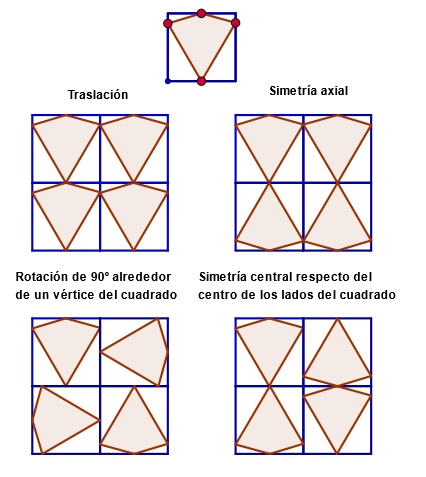
This GeoGebra example demonstrates planar “motions” by visually transforming geometric configurations, showing how key points and entire polygons change under translation, rotation, and reflection (mirror). It centers on concepts of geometric transformation and construction: creating base objects with Line and Circle, locating critical positions via Intersect (line–circle or line–line intersections), and assembling shapes using Polygon. The construction uses Point and Vector to define and control moving reference elements (such as A, B, and grouped points like d/e/f/g and H/I), then applies Translate, Rotate, and Mirror to produce transformed counterparts (e.g., poly1 to poly1', poly2 to poly2'). Midpoint is used to support symmetry/center-related constructions. Suitable for secondary-school geometry lessons on transformations and for students learning how rigid motions preserve structure.
GeoGebra Commands & Parameters
Line(A, B) → aCircle(A, b) → cIntersect(c, a, 2) → CPolygon(A, C, 4) → poly1, d, e, f, g, D, EPoint(f) → FPoint(g) → GPoint(d) → HPoint(e) → IPolygon(H, I, F, G) → poly2, h, i, f_1, g_1Vector(E, J) → uTranslate(A, u) → A'Translate(C, u) → C'Translate(D, u) → D'Translate(E, u) → E'Polygon(A', C', D', E') → poly1', a', c', d', e'Translate(H, u) → H'Translate(I, u) → I'Translate(F, u) → F'Translate(G, u) → G'Polygon(H', I', F', G') → poly2', h', i', f', g'Vector(D, K) → vVector(L, M) → wVector(L, N) → zTranslate(A, v) → A'_1Translate(C, v) → C'_1Translate(D, v) → D'_1Translate(E, v) → E'_1Polygon(A'_1, C'_1, D'_1, E'_1) → poly1'_1, a'_1, c'_1, d'_1, e'_1Translate(H, v) → H'_1Translate(I, v) → I'_1Translate(F, v) → F'_1Translate(G, v) → G'_1Polygon(H'_1, I'_1, F'_1, G'_1) → poly2'_1, h'_1, i'_1, f'_1, g'_1Vector(E, O) → jVector(D, P) → kTranslate(A, j) → A'_2Translate(C, j) → C'_2Translate(D, j) → D'_2Translate(E, j) → E'_2Polygon(A'_2, C'_2, D'_2, E'_2) → poly1'_2, a'_2, c'_2, d'_2, e'_2Translate(H, j) → H'_2Translate(I, j) → I'_2Translate(F, j) → F'_2Translate(G, j) → G'_2Polygon(H'_2, I'_2, F'_2, G'_2) → poly2'_2, h'_2, i'_2, f'_2, g'_2Translate(A, k) → A'_3Translate(C, k) → C'_3Translate(D, k) → D'_3Translate(E, k) → E'_3Polygon(A'_3, C'_3, D'_3, E'_3) → poly1'_3, a'_3, c'_3, d'_3, e'_3Translate(H, k) → H'_3Translate(I, k) → I'_3Translate(F, k) → F'_3Translate(G, k) → G'_3Polygon(H'_3, I'_3, F'_3, G'_3) → poly2'_3, h'_3, i'_3, f'_3, g'_3Translate(A', w) → A''Translate(C', w) → C''Translate(D', w) → D''Translate(E', w) → E''Polygon(A'', C'', D'', E'') → poly1'', a'', c'', d'', e''Translate(A', z) → A''_1Translate(C', z) → C''_1Translate(D', z) → D''_1Translate(E', z) → E''_1Polygon(A''_1, C''_1, D''_1, E''_1) → poly1''_1, a''_1, c''_1, d''_1, e''_1Translate(A'', z) → A'''Translate(C'', z) → C'''Translate(D'', z) → D'''Translate(E'', z) → E'''Polygon(A''', C''', D''', E''') → poly1''', a''', c''', d''', e'''Translate(A'_1, w) → QTranslate(C'_1, w) → RTranslate(D'_1, w) → STranslate(E'_1, w) → TPolygon(Q, R, S, T) → poly3, q, r, s, tTranslate(A'_1, z) → UTranslate(C'_1, z) → VTranslate(D'_1, z) → WTranslate(E'_1, z) → ZPolygon(U, V, W, Z) → poly4, u_1, v_1, w_1, z_1Translate(Q, z) → Q'Translate(R, z) → R'Translate(S, z) → S'Translate(T, z) → T'Polygon(Q', R', S', T') → poly3', q', r', s', t'Translate(A'_3, w) → A_1Translate(C'_3, w) → B_1Translate(D'_3, w) → C_1Translate(E'_3, w) → D_1Polygon(A_1, B_1, C_1, D_1) → poly5, a_1, b_1, c_1, d_1Translate(A'_3, z) → E_1Translate(C'_3, z) → F_1Translate(D'_3, z) → G_1Translate(E'_3, z) → H_1Polygon(E_1, F_1, G_1, H_1) → poly6, e_1, f_2, g_2, h_1Translate(A_1, z) → I_1Translate(B_1, z) → J_1Translate(C_1, z) → K_1Translate(D_1, z) → L_1Polygon(I_1, J_1, K_1, L_1) → poly5', i_1, j_1, k_1, l_1Translate(A'_2, w) → M_1Translate(C'_2, w) → N_1Translate(D'_2, w) → O_1Translate(E'_2, w) → P_1Polygon(M_1, N_1, O_1, P_1) → poly7, m_1, n_1, o_1, p_1Translate(A'_2, z) → Q_1Translate(C'_2, z) → R_1Translate(D'_2, z) → S_1Translate(E'_2, z) → T_1Polygon(Q_1, R_1, S_1, T_1) → poly8, q_1, r_1, s_1, t_1Translate(M_1, z) → U_1Translate(N_1, z) → V_1Translate(O_1, z) → W_1Translate(P_1, z) → Z_1Polygon(U_1, V_1, W_1, Z_1) → poly7', u_2, v_2, w_2, z_2Translate(H', w) → H''Translate(I', w) → I''Translate(F', w) → F''Translate(G', w) → G''Polygon(H'', I'', F'', G'') → poly2'', h'', i'', f'', g''Translate(H'', z) → H'''Translate(I'', z) → I'''Translate(F'', z) → F'''Translate(G'', z) → G'''Polygon(H''', I''', F''', G''') → poly2''', h''', i''', f''', g'''Translate(H', z) → H''_1Translate(I', z) → I''_1Translate(F', z) → F''_1Translate(G', z) → G''_1Polygon(H''_1, I''_1, F''_1, G''_1) → poly2''_1, h''_1, i''_1, f''_1, g''_1Mirror(H'_1, t) → A_2Mirror(I'_1, t) → B_2Mirror(F'_1, t) → C_2Mirror(G'_1, t) → D_2Polygon(A_2, B_2, C_2, D_2) → poly9, a_2, b_2, c_2, d_2Mirror(A_2, s') → E_2Mirror(B_2, s') → F_2Mirror(C_2, s') → G_2Mirror(D_2, s') → H_2Polygon(E_2, F_2, G_2, H_2) → poly9', e_2, f_3, g_3, h_2Mirror(H'_1, w_1) → I_2Mirror(I'_1, w_1) → J_2Mirror(F'_1, w_1) → K_2Mirror(G'_1, w_1) → L_2Polygon(I_2, J_2, K_2, L_2) → poly10, i_2, j_2, k_2, l_2Intersect(c'_3, d_1) → M_2Intersect(c'_3, d_1) → N_2Midpoint(c'_3) → O_2Midpoint(a_1) → P_2Mirror(H'_3, O_2) → R_2Mirror(I'_3, O_2) → S_2Mirror(F'_3, O_2) → T_2Mirror(G'_3, O_2) → U_2Polygon(R_2, S_2, T_2, U_2) → poly11, r_2, s_2, t_2, u_3Mirror(R_2, P_2) → V_2Mirror(S_2, P_2) → W_2Mirror(T_2, P_2) → Z_2Mirror(U_2, P_2) → A_3Polygon(V_2, W_2, Z_2, A_3) → poly11', v_3, w_3, z_3, a_3Mirror(V_2, Q_2) → B_3Mirror(W_2, Q_2) → C_3Mirror(Z_2, Q_2) → D_3Mirror(A_3, Q_2) → E_3Polygon(B_3, C_3, D_3, E_3) → poly11'', b_3, c_3, d_3, e_3Rotate(H'_2, 270°, C'_2) → F_3Rotate(I'_2, 270°, C'_2) → G_3Rotate(F'_2, 270°, C'_2) → H_3Rotate(G'_2, 270°, C'_2) → I_3Polygon(F_3, G_3, H_3, I_3) → poly12, f_4, g_4, h_3, i_3Rotate(F_3, 270°, C'_2) → J_3Rotate(G_3, 270°, C'_2) → K_3Rotate(H_3, 270°, C'_2) → L_3Rotate(I_3, 270°, C'_2) → M_3Polygon(J_3, K_3, L_3, M_3) → poly12', j_3, k_3, l_3, m_3Rotate(J_3, 270°, C'_2) → N_3Rotate(K_3, 270°, C'_2) → O_3Rotate(L_3, 270°, C'_2) → P_3Rotate(M_3, 270°, C'_2) → Q_3Polygon(N_3, O_3, P_3, Q_3) → poly12'', n_3, o_3, p_3, q_3
AI Drawing Prompt Reference
Draw two line segments and two circles, find their intersection points, and use these points to construct two quadrilaterals. Mark the key points of these quadrilaterals, define translations and rotations using vectors. Translate and rotate the quadrilaterals along the vectors, and draw the transformed shapes to demonstrate the effects of geometric transformations.
The prompt above was compiled from the original drawing commands and is for reference only.