
Secants Intersection Outside: Exploring the External Secant Theorem
Loading the math board and drawing, please wait…
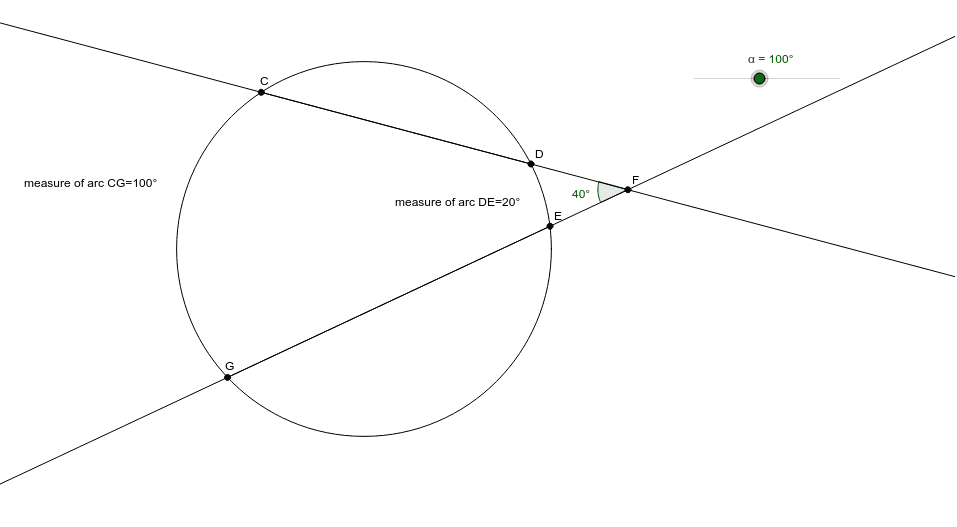
①This example demonstrates the geometric configuration of two secants drawn from an external point to a circle, intersecting the circle at four points, and illustrates the relationship between the external point and the intersection points, namely the secant theorem (external power theorem). ②Core mathematical concepts include secants of a circle, external intersection point, equality of products of segment lengths (PA·PB = PC·PD), symmetry, and angle relationships. ③Construction highlights: using GeoGebra commands such as Circle, Point, Line, Rotate, Angle, Intersect, Segment, and LineBisector to construct the circle, external point, two secants, and their intersection points; angles are labeled via the Angle tool, and line bisectors are used to analyze symmetry. ④Suitable for high school geometry or introductory college geometry courses, providing an interactive way to understand the power of a point theorem and to dynamically explore the invariance of the product of segment lengths as the secants vary.
GeoGebra Commands & Parameters
Circle(A, B) → cPoint(c) → CPoint(c) → DLine(C, D) → aRotate(C, α, A) → GAngle(C, A, G) → βLine(G, A) → bLine(C, A) → dPoint(c) → ELine(G, E) → eIntersect(a, e) → FAngle(D, F, E) → γSegment(C, D) → fSegment(E, G) → gLineBisector(f) → hLineBisector(g) → iIntersect(h, i) → G_1Segment(G_1, D) → jSegment(G_1, E) → kAngle(E, G_1, D) → δ