
Sean Jackson's GeoGebra Constructions
Loading the math board and drawing, please wait…
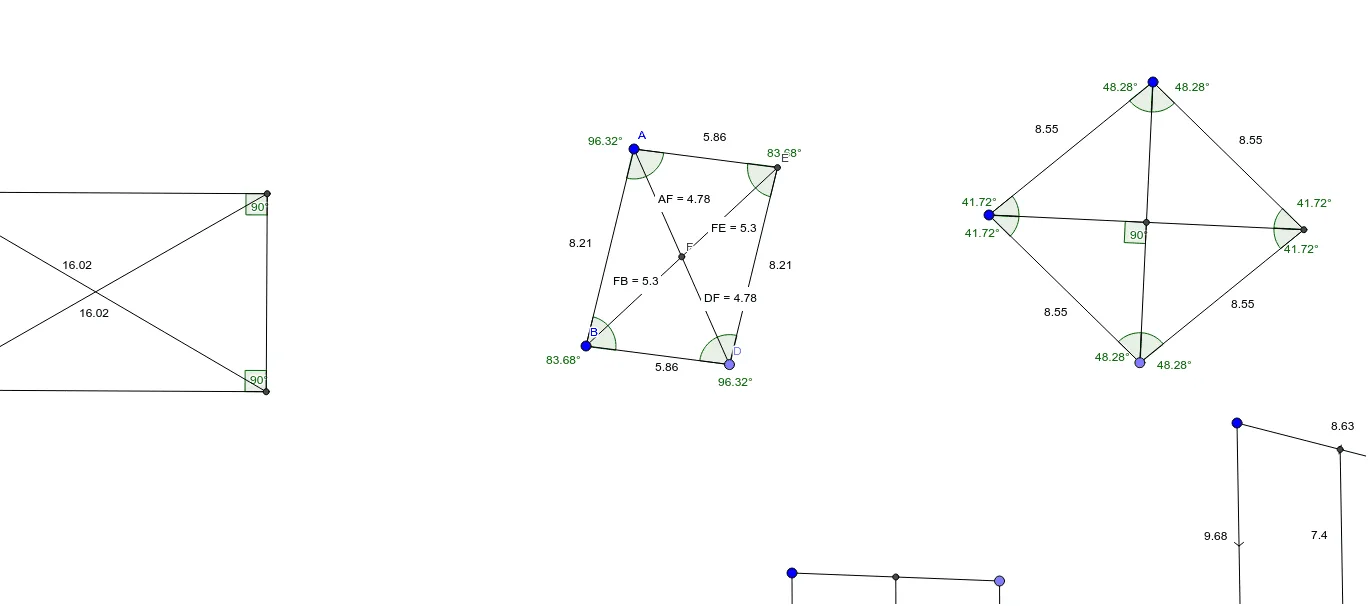
This example showcases a series of geometric constructions by Sean Jackson, including segments, lines, points, intersections, angles, distances, circles, and midpoints. Using GeoGebra commands such as Segment, Line, Point, Intersect, Angle, Distance, Circle, and Midpoint, complex geometric shapes can be constructed. Suitable for middle school and above students to learn geometric constructions and related concepts.
GeoGebra Commands & Parameters
Segment(A, B) → aLine(C, a) → bPoint(b) → DSegment(B, D) → cLine(A, c) → dIntersect(b, d) → ESegment(D, E) → eSegment(A, E) → fAngle(B, A, E) → αAngle(A, E, D) → βAngle(E, D, B) → γAngle(D, B, A) → δSegment(E, B) → hSegment(A, D) → gIntersect(h, g) → FDistance(A, F) → distanceAFDistance(F, E) → distanceFEDistance(D, F) → distanceDFDistance(F, B) → distanceFBSegment(G, H) → iCircle(G, H) → kPoint(k) → JSegment(G, J) → jCircle(G, H) → qLine(J, i) → lLine(H, j) → mIntersect(l, m) → KSegment(J, K) → nSegment(K, H) → pSegment(H, J) → rSegment(G, K) → sIntersect(r, s) → LAngle(G, L, J) → εAngle(K, J, L) → ζAngle(L, J, G) → ηAngle(J, G, L) → θAngle(L, G, H) → ιAngle(G, H, L) → κAngle(L, H, K) → λAngle(H, K, L) → μAngle(L, K, J) → νSegment(M, N) → tLine(O, t) → a_1OrthogonalLine(N, t) → b_1OrthogonalLine(M, t) → c_1Intersect(a_1, c_1) → PIntersect(a_1, b_1) → QSegment(N, Q) → d_1Segment(Q, P) → e_1Segment(P, M) → f_1Angle(M, N, Q) → ξAngle(N, Q, P) → οAngle(Q, P, M) → ρAngle(P, M, N) → σSegment(N, P) → g_1Segment(Q, M) → h_1Segment(R, S) → i_1Circle(R, S) → k_1OrthogonalLine(R, i_1) → j_1Circle(R, S) → p_1Intersect(p_1, j_1, 1) → TLine(T, i_1) → l_1OrthogonalLine(S, i_1) → m_1Intersect(l_1, m_1) → UIntersect(j_1, l_1) → VSegment(V, R) → n_1Segment(U, S) → q_1Segment(V, U) → r_1Segment(R, U) → s_1Segment(S, V) → t_1Intersect(s_1, t_1) → WAngle(U, W, S) → τAngle(S, W, R) → υAngle(R, W, V) → ϕSegment(Z, A_1) → a_2Line(B_1, a_2) → b_2Point(b_2) → C_1Segment(Z, C_1) → c_2Segment(A_1, B_1) → d_2Segment(C_1, B_1) → e_2Midpoint(c_2) → D_1Midpoint(d_2) → E_1Segment(D_1, E_1) → f_2Segment(F_1, G_1) → g_2Line(H_1, g_2) → h_2Point(h_2) → I_1Segment(F_1, I_1) → i_2Midpoint(g_2) → J_1OrthogonalLine(J_1, g_2) → j_2Mirror(F_1, j_2) → K_1Mirror(I_1, j_2) → L_1Segment(K_1, L_1) → k_2Segment(I_1, L_1) → l_2Midpoint(i_2) → M_1Midpoint(k_2) → N_1Segment(M_1, N_1) → m_2Segment(P_1, Q_1) → p_2Midpoint(p_2) → R_1OrthogonalLine(R_1, p_2) → q_2Point(q_2) → O_1Segment(P_1, O_1) → n_2Mirror(P_1, q_2) → S_1Mirror(O_1, q_2) → T_1Segment(S_1, T_1) → r_2Point(q_2) → U_1Segment(Q_1, U_1) → s_2Mirror(Q_1, q_2) → V_1Mirror(U_1, q_2) → W_1Segment(V_1, W_1) → t_2Segment(O_1, U_1) → a_3Intersect(p_2, a_3) → Z_1Angle(Q_1, Z_1, O_1) → ψAngle(U_1, P_1, O_1) → χAngle(O_1, Q_1, U_1) → α_1Angle(V, R, S) → ωAngle(S, U, V) → β_1Angle(W, V, R) → γ_1Angle(W, S, U) → δ_1