
Scalars vs Vectors: Interactive Geometric and Algebraic Demonstration
Loading the math board and drawing, please wait…
In collections
Vector Basics
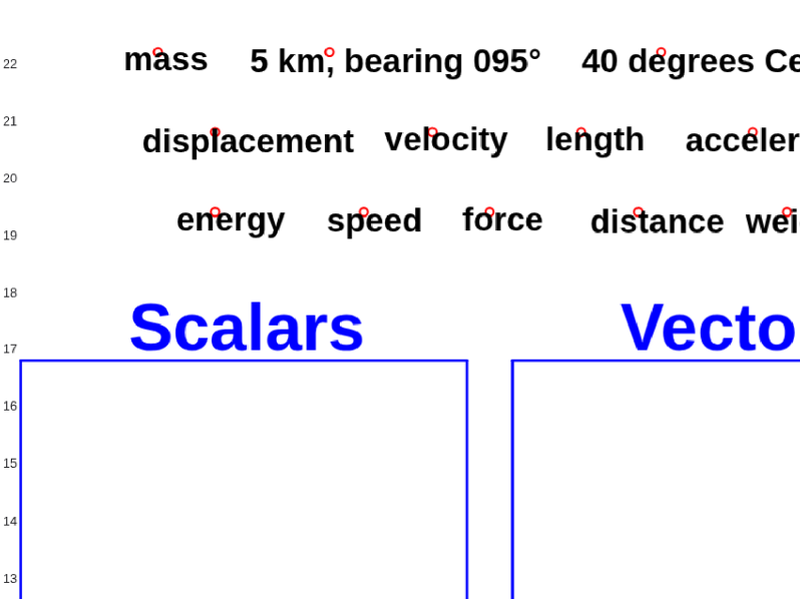
① This GeoGebra example visually demonstrates the difference between scalars (magnitude only) and vectors (magnitude and direction) using geometric shapes such as polygons and equilateral triangles. ② Core mathematical concepts include vector and scalar definitions, vector operations (scaling, translation), matrix transformations (dilation, rotation), and the role of vectors in linear regression and scalar growth in interest calculations. ③ Construction details: The summary lists commands Polygon and If, with objects including multiple points (A, B, C, D, etc.), segments (a, b, c, d), text boxes (text1 to text10) for labels, and containers Box1, Box2. It also involves Dilation and Linear Regression objects, illustrating how vectors and scalars apply across different math topics. ④ Suitable for high school to early college students learning vector algebra, linear algebra, or mathematical modeling; also useful for teachers to demonstrate the conceptual distinction and practical applications in geometry and data analysis.
GeoGebra Commands & Parameters
Polygon(A_2, B_2, C_2, D_2) → Box1, a, b, c, dPolygon(A_1, B_1, C_1, D_1) → Box2, a_1, b_1, c_1, d_1If(A ∈ Box1, 1, 0) → Ans1If(B ∈ Box1, 1, 0) → Ans2If(C ∈ Box1, 1, 0) → Ans3If(D ∈ Box1, 1, 0) → Ans4If(E ∈ Box1, 1, 0) → Ans5If(F ∈ Box1, 1, 0) → Ans6If(H ∈ Box2, 1, 0) → Ans8If(G ∈ Box2, 1, 0) → Ans7If(I ∈ Box2, 1, 0) → Ans9If(J ∈ Box2, 1, 0) → Ans10If(K ∈ Box2, 1, 0) → Ans11If(L ∈ Box2, 1, 0) → Ans12