
Scalar Multiplication Using Components
Loading the math board and drawing, please wait…
In collections
Vector Basics
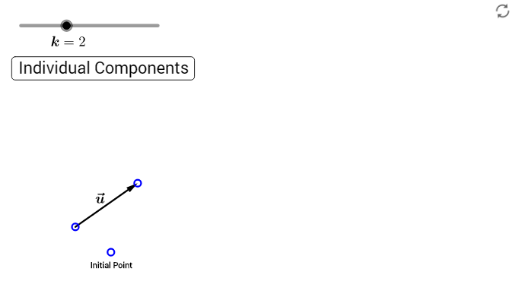
This GeoGebra example demonstrates scalar multiplication of vectors using their components, visually showing how a vector is scaled by a scalar factor. The core mathematical concept is linear operations on vectors, specifically scalar multiplication and its effect on vector direction and magnitude. The construction uses GeoGebra commands such as Vector, Translate, Segment, Point, and Midpoint to create the original vector u, auxiliary points and segments, and a slider k to control the scaling factor. Multiple scaled copies (C', C'', etc.) are generated to illustrate the transformation. This resource is suitable for high school or early college courses in analytic geometry or linear algebra, helping students grasp the geometric meaning of vector scaling and explore dynamic variations with different coefficients.
GeoGebra Commands & Parameters
Vector(A, B) → uTranslate(C, Fin) → EndCSegment(C, EndC) → CEndCTranslate(C, u) → C'Translate(C', u) → C''Translate(C'', u) → C'''Translate(C''', u) → C''''Segment(C, C') → aSegment(C', C'') → bSegment(C'', C''') → cSegment(C''', C'''') → dSegment(A, C) → a'Segment(A, C') → b'Segment(A, C'') → c'Segment(A, C''') → d'Point(a', n) → A_1Point(b', n - 1) → B_1Translate(A_1, u) → DVector(A_1, D) → a_1Translate(B_1, u) → EVector(B_1, E) → b_1Point(CEndC, n_1) → AlmEndVector(C, AlmEnd) → EndPoint(c', n - 2) → C_1Point(d', n - 3) → D_1Translate(C_1, u) → FVector(C_1, F) → c_1Translate(D_1, u) → GVector(D_1, G) → d_1Translate(A, Vector[(-u)]) → A'Midpoint(C, AlmEnd) → MidSegment(C, I) → eSegment(C', I') → fSegment(C'', I'') → gSegment(C''', I''') → hPoint(e, ((n - abs(k)) * 2 / abs(k))) → HPoint(f, ((n - abs(k)) * 2 / abs(k))) → JPoint(g, ((n - abs(k)) * 2 / abs(k))) → KPoint(h, ((n - abs(k)) * 2 / abs(k))) → LSegment(C'', K) → iSegment(C''', L) → jSegment(C, H) → vSegment(C', J) → wSegment(I, C') → lSegment(I', C'') → mSegment(I'', C''') → pSegment(I''', C'''') → qPoint(l, ((n - abs(k)) * 2 / abs(k))) → MPoint(m, ((n - abs(k)) * 2 / abs(k))) → NPoint(p, ((n - abs(k)) * 2 / abs(k))) → OPoint(q, ((n - abs(k)) * 2 / abs(k))) → PSegment(I, M) → rSegment(I', N) → sSegment(I'', O) → tSegment(I''', P) → e_1Segment(C, Q) → f_1Segment(Q, EndC) → g_1Point(f_1, n_1 - 1) → RPoint(g_1, n_1 - 1) → SSegment(C, R) → h_1Segment(Q, S) → i_1