
SAS Similarity Theorem Exploration by Kevin Agnew
Loading the math board and drawing, please wait…
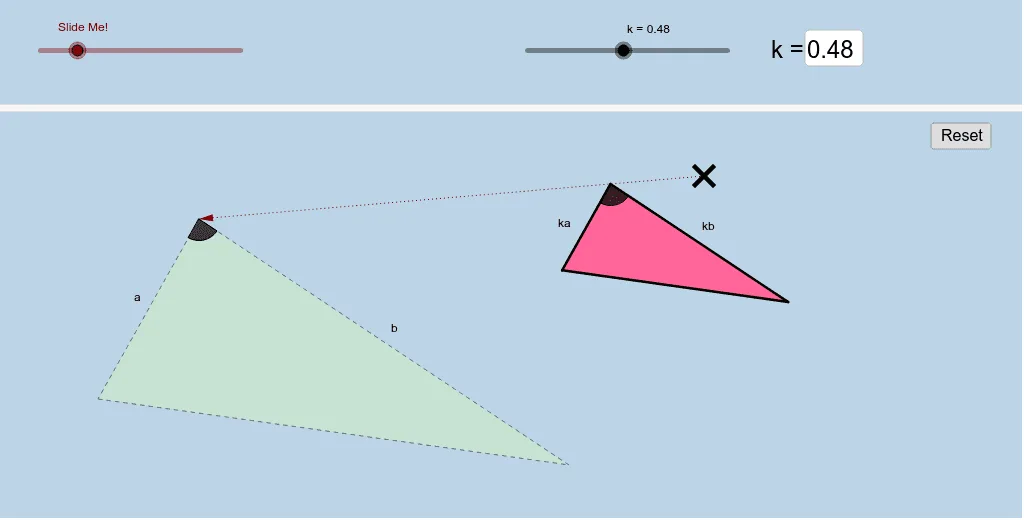
This GeoGebra applet dynamically demonstrates the SAS Similarity Theorem for triangles. Key mathematical concepts include similar triangles and triangle geometry. Using commands like Segment, Vector, Dilate, and Polygon, students can visually explore the properties of similar triangles. Suitable for middle school and above students to learn about similar triangles.
GeoGebra Commands & Parameters
Segment(A, B) → aSegment(B, C) → b_2Segment(C, A) → bVector(A, D) → uDilate(A, k, A) → A'Dilate(B, k, A) → B'Segment(A', B') → a'_2Dilate(C, k, A) → C'Dilate(A, k, A) → A'_1Segment(C', A'_1) → c'Dilate(B, k, A) → B'_1Dilate(C, k, A) → C'_1Segment(B'_1, C'_1) → b'_2Polygon(A'_1, B'_1, C'_1) → poly1, c'_1, a'_1, b'_1Dilate(A, m, D) → A'_2Vector(A, A'_2) → vTranslate(A'_1, v) → ETranslate(B'_1, v) → FTranslate(C'_1, v) → GPolygon(E, F, G) → poly1', g, e, fPolygon(A, C, B) → poly2, b_1, a_1, c_1Segment(F, A'_2) → a'Segment(A'_2, G) → b'Segment(G, F) → iAngle(B, A, C) → αVector(D, A) → wCircle(A, 0.5) → pIntersect(p, a) → H,Intersect(p, b) → I,Circle(A'_2, 0.5) → qIntersect(q, a', 1) → JIntersect(q, b', 1) → KCircleSector(A'_2, J, K) → rCircleSector(A, H, I) → sAngle(H, A, I) → βCircleSector(A, I, H) → tCircleSector(A'_2, K, J) → d_1Circle(B, 0.5) → cCircle(F, 0.5) → dIntersect(c, b_2, 1) → LIntersect(c, a, 1) → MIntersect(d, i, 1) → NIntersect(d, a', 1) → OCircleSector(F, N, O) → hCircleSector(B, L, M) → e_1CircleSector(F, O, N) → f_1Dilate(F, 1 - j, B) → F'Vector(F, F') → lTranslate(h, l) → h'Translate(f_1, l) → g_1Textfield(k) → InputBox1