
Inverse Trigonometric Ratios
Loading the math board and drawing, please wait…
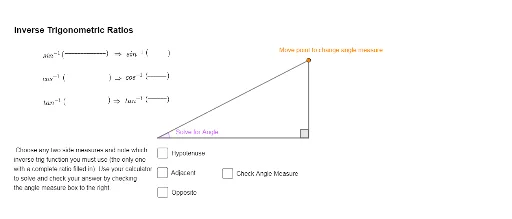
This example demonstrates the concept of inverse trigonometric ratios. By constructing a circle and a triangle, it shows the relationship between angles and inverse trigonometric function values. GeoGebra commands used include Intersect, Circle, Segment, Line, and OrthogonalLine. Suitable for high school math education, helping students understand the geometric meaning of inverse trigonometric functions.
GeoGebra Commands & Parameters
Intersect(xAxis, yAxis) → APoint(xAxis) → BCircle(A, B) → cPoint(c) → CSegment(A, C) → fLine(A, B) → gOrthogonalLine(C, g) → hIntersect(h, g) → DSegment(A, D) → iSegment(C, D) → jAngle(C, A, D) → αAngle(C, D, A) → βSegment(A, C) → kSegment(C, D) → lSegment(A, D) → m
AI Drawing Prompt Reference
Draw a coordinate plane with a circle centered at the origin. Place a point on the circle and connect it to the center to form a radius. From the center, draw a horizontal ray. From the point on the circle, draw a perpendicular line to this ray, meeting it at a foot. Connect the center to the foot and the point to the foot, forming a right triangle. Label the angle at the center as α and the angle at the foot as β. This illustrates inverse trigonometric ratios.
The prompt above was compiled from the original drawing commands and is for reference only.