
SAS Congruence Postulate by kherdegen
Loading the math board and drawing, please wait…
In collections
Chapter 4 - Triangle Congruence - Geometry
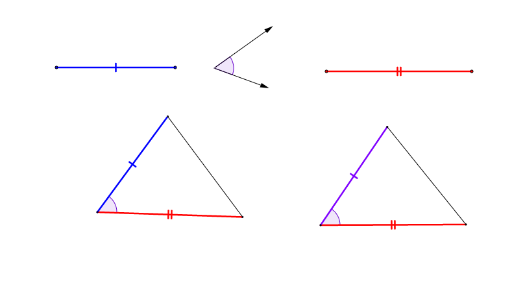
This example illustrates the SAS Congruence Postulate. By constructing two triangles, it demonstrates that if two sides and the included angle of one triangle are equal to two sides and the included angle of another triangle, then the two triangles are congruent. The construction uses Segment, Vector, Circle, Point, Intersect, Line, and Angle commands in GeoGebra. Suitable for middle school and above students to learn about congruent triangles.
GeoGebra Commands & Parameters
Segment(A, B) → fSegment(C, D) → gVector(E, F) → uVector(E, G) → vCircle(H, Segment[A, B]) → cPoint(c) → ISegment(H, I) → hCircle(H, Segment[C, D]) → dCircle(H, Segment[E, G]) → eCircle(H, Segment[E, F]) → kIntersect(e, h, 1) → JCircle(J, Segment[G, F]) → pIntersect(k, p, 1) → KLine(H, K) → iIntersect(d, i, 2) → LSegment(H, L) → jSegment(L, I) → lAngle(G, E, F) → αAngle(I, H, L) → βCircle(M, Segment[A, B]) → qPoint(q) → NSegment(M, N) → mCircle(M, Segment[E, G]) → rCircle(M, Segment[E, F]) → sIntersect(r, m, 1) → OCircle(O, Segment[G, F]) → tIntersect(s, t, 1) → PLine(M, P) → nCircle(M, Segment[D, C]) → c_1Intersect(c_1, n, 2) → QSegment(N, Q) → aSegment(Q, M) → bAngle(N, M, Q) → γ