
Rules for Translations
Loading the math board and drawing, please wait…
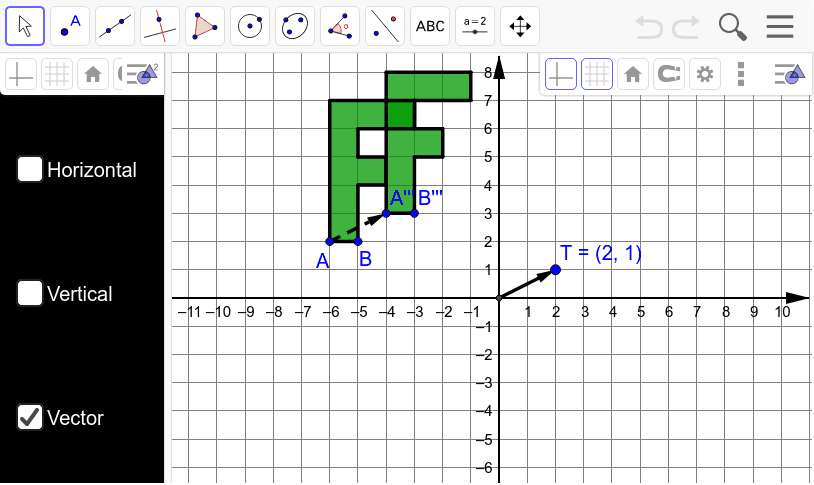
This example demonstrates the application of translation transformations in geometry, defining translation using vectors and observing the changes in shapes. Core math concepts include vectors, translation transformations, and polygon construction. It utilizes GeoGebra commands and objects like Polygon, Intersect, Vector, and Translate. Suitable for high school students learning coordinate geometry, vectors, and geometric transformations to understand the properties and practical applications of translations.
GeoGebra Commands & Parameters
Polygon(A, B, 4) → poly1, f, g, h_2, i, C, DPolygon(D, C, 4) → poly2, j, k, l, m, E, FPolygon(F, E, 4) → poly3, n, p, q, r, G, HPolygon(H, G, 4) → poly4, s, t, a, b, I, JPolygon(J, I, 4) → poly5, c, d, e, f_1, K, LPolygon(K, I, 4) → poly6, g_1, h_1, i_1, j_1, M, NPolygon(N, M, 4) → poly7, k_1, l_1, m_1, n_1, O, PPolygon(G, E, 4) → poly8, p_1, q_1, r_1, s_1, Q, RPolygon(A, L, P, O, I, G, R, Q, E, B) → poly9, a_1, b_1, l_2, p_2, o, i_2, g_2, r_2, q_2, e_1Intersect(xAxis, yAxis) → SVector(S, U) → uVector(S, T_1) → u_1Translate(A, u_1) → A'Translate(L, u_1) → L'Translate(P, u_1) → P'Translate(O, u_1) → O'Translate(I, u_1) → I'Translate(G, u_1) → G'Translate(R, u_1) → R'Translate(Q, u_1) → Q'Translate(E, u_1) → E'Translate(B, u_1) → B'Polygon(A', L', P', O', I', G', R', Q', E', B') → poly9', a', b', l', p', o', i', g', r', q', e'Vector(S, T) → v_1Translate(A, u) → A''Translate(L, u) → L'_1Translate(P, u) → P'_1Translate(O, u) → O'_1Translate(I, u) → I'_1Translate(G, u) → G'_1Translate(R, u) → R'_1Translate(Q, u) → Q'_1Translate(E, u) → E'_1Translate(B, u) → B''Polygon(A'', L'_1, P'_1, O'_1, I'_1, G'_1, R'_1, Q'_1, E'_1, B'') → poly9'_1, a'_1, b'_1, l'_1, p'_1, o'_1, i'_1, g'_1, r'_1, q'_1, e'_1Translate(A, v_1) → A'''Translate(L, v_1) → L'_2Translate(P, v_1) → P'_2Translate(O, v_1) → O'_2Translate(I, v_1) → I'_2Translate(G, v_1) → G'_2Translate(R, v_1) → R'_2Translate(Q, v_1) → Q'_2Translate(E, v_1) → E'_2Translate(B, v_1) → B'''Polygon(A''', L'_2, P'_2, O'_2, I'_2, G'_2, R'_2, Q'_2, E'_2, B''') → poly9'_2, a'_2, b'_2, l'_2, p'_2, o'_2, i'_2, g'_2, r'_2, q'_2, e'_2Vector(A, A') → d_1Vector(A, A'') → t_1Vector(A, A''') → w_1
AI Drawing Prompt Reference
Draw a star-shaped pattern made of five squares centered at the origin, with the vertices of each square connecting sequentially. Apply two different vector translations to the entire pattern to demonstrate the effect of translation transformations.
The prompt above was compiled from the original drawing commands and is for reference only.