
Rotations: Demonstrating Polygon and Line Rotation
Loading the math board and drawing, please wait…
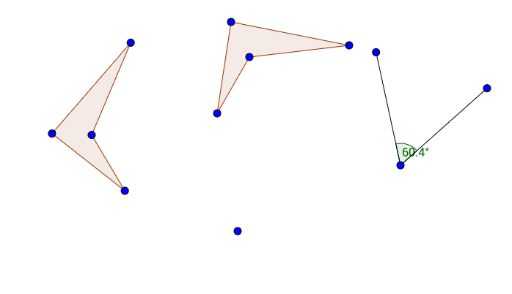
① This GeoGebra example dynamically shows a polygon and its side lines rotating around a point, clearly illustrating the positional and shape relationships before and after rotation. ② Core mathematical concepts include rotation transformation, center of rotation, rotation angle, similar triangles, and the behavior of quadratic functions and exponents under rotation, along with geometric properties of lines, polygons, and angles. ③ Construction highlights: using commands such as Circle, Polygon, Point, Angle, Segment, and Rotate, it constructs objects I, G, e, A, B, C, D, poly1 and their rotated counterparts A', B', C', D', poly1', with lines a, b, c, d and a', b', c', d' representing pre- and post-rotation sides, angle α controlling the rotation, and f, g possibly serving as auxiliary functions or loci. ④ Suitable for middle and high school geometry teaching, math labs, or dynamic geometry exploration, helping students grasp the distance- and angle-preserving properties of rotation.
GeoGebra Commands & Parameters
Circle(G, I) → ePolygon(A, B, C, D) → poly1, a, b, c, dPoint(e) → HPoint(e) → FAngle(F, G, H) → αSegment(G, F) → fSegment(G, H) → gRotate(A, α, E) → A'Rotate(B, α, E) → B'Rotate(C, α, E) → C'Rotate(D, α, E) → D'Polygon(A', B', C', D') → poly1', a', b', c', d'