
Rotational Symmetry of a Cube by Yip Wing Chung, Felix
Loading the math board and drawing, please wait…
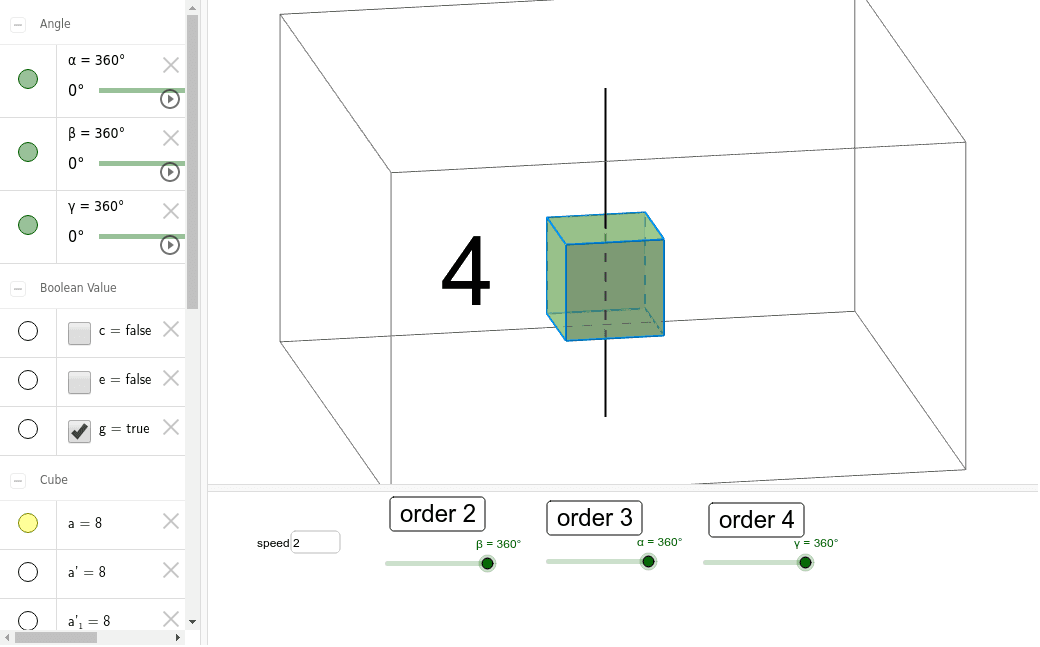
This GeoGebra interactive example dynamically illustrates the rotational symmetry of a regular cube in three-dimensional space. Users can rotate the cube about its center to observe multiple orders of symmetry, where the cube maps onto itself at specific angles. The construction leverages core geometric transformation concepts, including rotation about a point, spatial symmetry axes, and invariant properties under rigid motions. Key mathematical concepts covered include three-dimensional geometry, rotational symmetry groups, and the relationship between rotation angles and symmetry order. The example is built using GeoGebra commands such as Point, Cube, Line, Midpoint, Rotate, and Centroid, with labeled faces, edges, and symmetry elements. It is suitable for middle school and high school geometry classes, undergraduate introductory geometry or linear algebra courses, and anyone interested in visualizing spatial symmetry and transformation geometry.
GeoGebra Commands & Parameters
Point(xAxis) → APoint(xAxis) → BPoint(Circle[B, Distance[A, B], Segment[A, B]]) → CCube(A, B, C) → a, D, faceCDHG, faceEFGH, edgeAD, edgeAB, edgeBC, edgeCD, edgeAE, edgeDH, edgeEH, edgeEF, E, edgeBF, edgeFG, edgeCG, edgeGH, F, G, H, faceABCD, faceADHE, faceABFE, faceBCGFLine(C, E) → bMidpoint(edgeAD) → IMidpoint(edgeFG) → JLine(I, J) → dRotate(a, (-β), d) → a'_1Centroid(faceEFGH) → KCentroid(faceABCD) → LLine(L, K) → fRotate(a, (-α), b) → a'Textfield(speed) → InputBox1Div(β, 180°) → order2Div(α, 120°) → order3Div(γ, 90°) → order4Rotate(a, (-γ), f) → a'_2