
Rotational Motion: Ants on a Disk
Loading the math board and drawing, please wait…
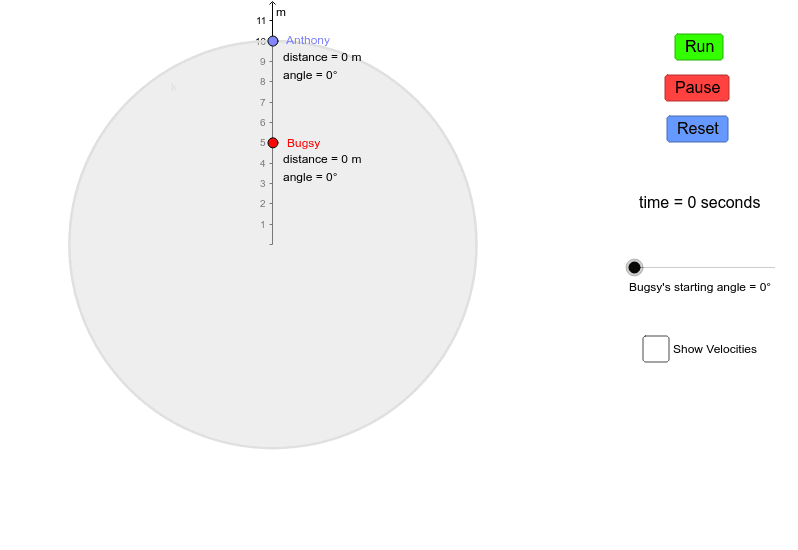
This simulation shows two ants on a rotating disk, displaying their angles and distances covered. Students can compare angles and distances. The example demonstrates rotational motion and the movement轨迹 of ants, involving core math concepts like angles, distances, ratios, and differential calculus. Construction highlights the use of GeoGebra commands and objects such as Mod, Ray, Point, CircleSector, If, Circle, Intersect, CircleArc, Length. Suitable for high school students learning rotational motion and statistical characteristics.
GeoGebra Commands & Parameters
Mod((scale * t), 360) → αRay(C, (1; ((-α) + 90)° - β)) → brayPoint(bray) → BugsyCircleSector(C, Bugsy, G) → eIf(Bugsy ≟ (0, 0), 0, Length[e]) → blen2Ray(C, (1; ((-α) + 90)°)) → arayPoint(aray) → AnthonyCircle(C, Anthony) → dIntersect(d, yAxis) → D, ECircleSector(C, Anthony, E) → fIf(Anthony ≟ (0, 0), 0, Length[f]) → alen2Circle(C, Bugsy) → cCircleArc(C, Anthony, E) → gCircleArc(C, Bugsy, G) → hLength(f) → alenLength(e) → blenCircle(C, 10) → k
AI Drawing Prompt Reference
Draw a disk with center C and radius 10. Place two ants on the disk, labeled Anthony and Bugsy. Draw two rays from C, one to Anthony and one to Bugsy. Draw two circular arcs with C as the center and Anthony and Bugsy as endpoints. Draw two circular sectors with Anthony and Bugsy as endpoints. Calculate and display the lengths of the arcs.
The prompt above was compiled from the original drawing commands and is for reference only.