
Rotation and Translation: Demonstrating Polygon Transformations in 3D
Loading the math board and drawing, please wait…
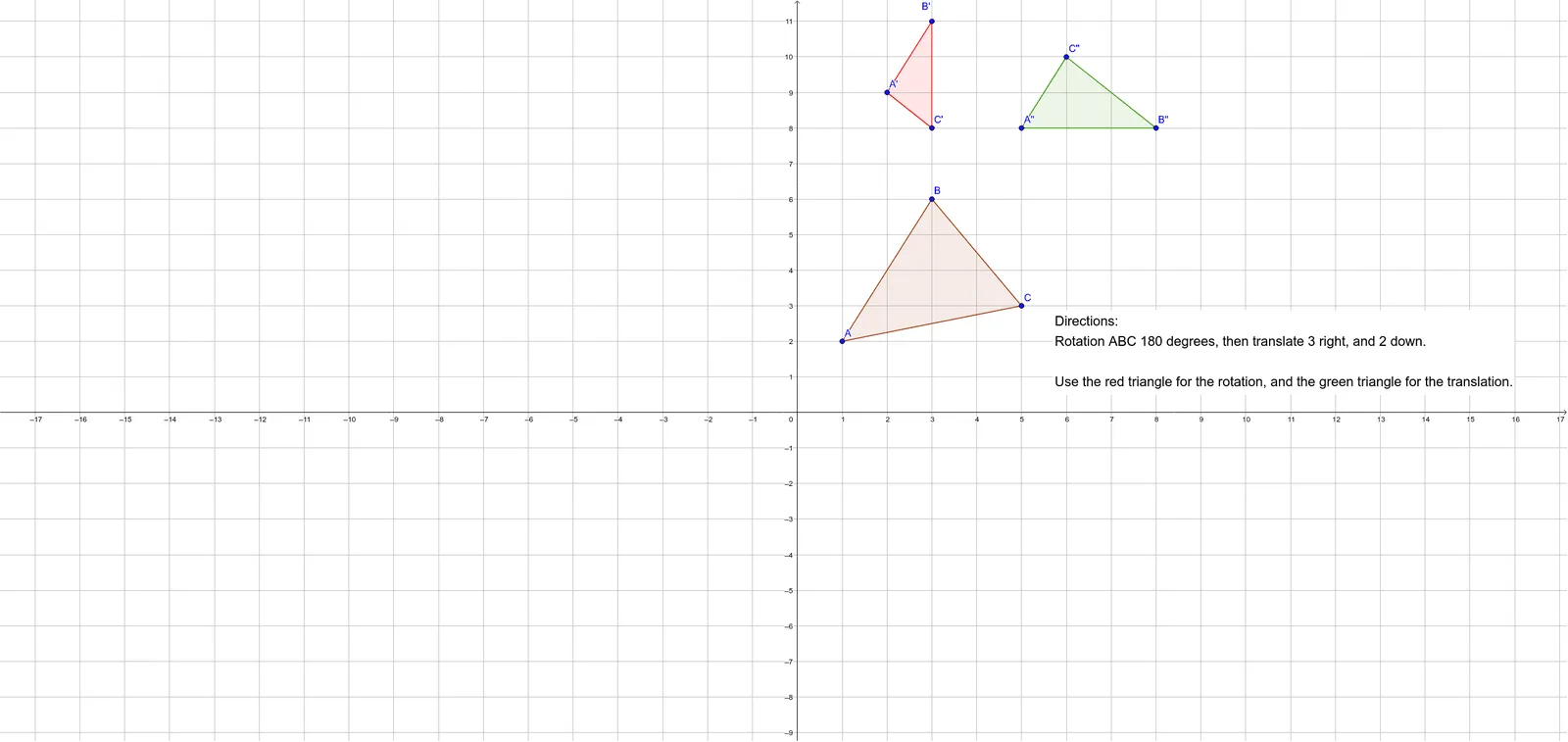
① This GeoGebra example demonstrates the composite transformation of a polygon in 3D space, first rotating it and then translating it, to visually show how the shape's position and orientation change. ② Core mathematical concepts include 3D rotation, translation, vector operations, and composition of transformations, with additional elements like circumcircles, secant lines, and step functions enriching the context. ③ Construction highlights: The initial polygon poly1 is created using the Polygon command, then rotated via the Rotate command to produce poly1', and finally translated using a vector defined by the Vector command and the Translate command to obtain poly1''. Intersect is used to find intersection points, and multiple auxiliary objects (points, lines, circles) and text labels are generated to complete the transformation chain. ④ This is suitable for high school or early college students learning 3D geometric transformations, and can serve as an interactive teaching tool or a self-exploration resource to understand the geometric meaning of rotation matrices and translation vectors.
GeoGebra Commands & Parameters
Polygon(A, B, C) → poly1, c, a, bPolygon(E, F, G) → poly2, g, e, fPolygon(H, I, J) → poly3, j, h, iIntersect(xAxis, yAxis) → DRotate(A, 180°, D) → A'Rotate(B, 180°, D) → B'Rotate(C, 180°, D) → C'Polygon(A', B', C') → poly1', c', a', b'Vector(K, L) → uTranslate(A', u) → A''Translate(B', u) → B''Translate(C', u) → C''Polygon(A'', B'', C'') → poly1'', c'', a'', b''
AI Drawing Prompt Reference
Draw a triangle in 3D space, rotate it 180 degrees around the origin to get a second triangle, then translate it along a given vector to get a third triangle. Also draw three auxiliary triangles and mark the intersection of the coordinate axes. Show the composite transformation of rotation and translation, using different colors for the original, rotated, and translated triangles, and add necessary auxiliary lines and labels to illustrate the transformation relationships.
The prompt above was compiled from the original drawing commands and is for reference only.