
Rotation and Shrinking Demo
Loading the math board and drawing, please wait…
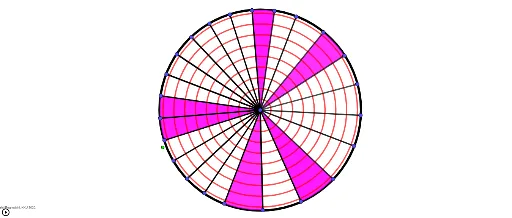
This example demonstrates a dynamic effect of a shape rotating and shrinking simultaneously. It involves core mathematical concepts such as rotation, dilation, circle, and trigonometric functions. The construction utilizes commands like Mirror, Segment, CircleSector, Circle, Rotate, Dilate, Vector, and Translate from GeoGebra. It is suitable for high school students and teachers studying geometric transformations, function graphs, and dynamic geometry.
GeoGebra Commands & Parameters
Mirror(U, f) → U'Mirror(V, f) → V'Mirror(T, f) → T'Mirror(S, f) → S'Mirror(R, f) → R'Mirror(Q, f) → Q'Mirror(P, f) → P'Segment(A, P) → gSegment(A, Q) → hSegment(R, A) → iSegment(S, A) → jSegment(A, T) → kSegment(U, A) → lSegment(A, V) → mSegment(C, A) → nSegment(A, D) → pSegment(A, E) → qSegment(A, F) → rSegment(A, G) → sSegment(A, V') → tSegment(U', A) → aSegment(A, T') → bSegment(S', A) → dSegment(A, R') → eSegment(Q', A) → f_1Segment(A, P') → g_1Segment(B, A) → h_1CircleSector(A, P, Q) → c_1CircleSector(A, Q, R) → d_1CircleSector(A, U', T') → e_1CircleSector(A, D, E) → k_1Segment(H, A) → i_1Segment(A, I) → j_1Segment(J, A) → l_1CircleSector(A, H, I) → p_1CircleSector(A, I, J) → q_1Segment(A, O) → m_1CircleSector(A, V, C) → r_1Circle(A, 5.019) → cRotate(S, (-(D7°)), A) → S'_1Rotate(A, (-(D7°)), A) → A'Segment(S'_1, A') → j'Rotate(d_1, (-(D7°)), A) → s_1Rotate(e_1, (-(D7°)), A) → c_2Rotate(q_1, (-(D7°)), A) → d_2Rotate(k_1, (-(D7°)), A) → e_2Rotate(r_1, (-(D7°)), A) → f_2Rotate(A, (-(D7°)), A) → A'_1Rotate(P, (-(D7°)), A) → P'_1Segment(A'_1, P'_1) → g'Rotate(A, (-(D7°)), A) → A'_2Rotate(Q, (-(D7°)), A) → Q'_1Segment(A'_2, Q'_1) → h'Rotate(R, (-(D7°)), A) → R'_1Rotate(A, (-(D7°)), A) → A'_3Segment(R'_1, A'_3) → i'Rotate(A, (-(D7°)), A) → A'_4Rotate(T, (-(D7°)), A) → T'_1Segment(A'_4, T'_1) → k'Rotate(U, (-(D7°)), A) → U'_1Rotate(A, (-(D7°)), A) → A'_5Segment(U'_1, A'_5) → l'Rotate(A, (-(D7°)), A) → A'_6Rotate(V, (-(D7°)), A) → V'_1Segment(A'_6, V'_1) → m'Rotate(C, (-(D7°)), A) → C'Rotate(A, (-(D7°)), A) → A'_7Segment(C', A'_7) → n'Rotate(A, (-(D7°)), A) → A'_8Rotate(D, (-(D7°)), A) → D'Segment(A'_8, D') → p'Rotate(A, (-(D7°)), A) → A'_9Rotate(E, (-(D7°)), A) → E'Segment(A'_9, E') → q'Rotate(A, (-(D7°)), A) → A'_{10}Rotate(F, (-(D7°)), A) → F'Segment(A'_{10}, F') → r'Rotate(A, (-(D7°)), A) → A'_{11}Rotate(V', (-(D7°)), A) → V''Segment(A'_{11}, V'') → t'Rotate(U', (-(D7°)), A) → U''Rotate(A, (-(D7°)), A) → A'_{12}Segment(U'', A'_{12}) → a'Rotate(A, (-(D7°)), A) → A'_{13}Rotate(T', (-(D7°)), A) → T''Segment(A'_{13}, T'') → b'Rotate(S', (-(D7°)), A) → S''Rotate(A, (-(D7°)), A) → A'_{14}Segment(S'', A'_{14}) → d'Rotate(A, (-(D7°)), A) → A'_{15}Rotate(R', (-(D7°)), A) → R''Segment(A'_{15}, R'') → e'Rotate(Q', (-(D7°)), A) → Q''Rotate(A, (-(D7°)), A) → A'_{16}Segment(Q'', A'_{16}) → n_1Rotate(A, (-(D7°)), A) → A'_{17}Rotate(P', (-(D7°)), A) → P''Segment(A'_{17}, P'') → a_1Rotate(B, (-(D7°)), A) → B'Rotate(A, (-(D7°)), A) → A'_{18}Segment(B', A'_{18}) → b_1Rotate(H, (-(D7°)), A) → H'Rotate(A, (-(D7°)), A) → A'_{19}Segment(H', A'_{19}) → h_2Rotate(A, (-(D7°)), A) → A'_{20}Rotate(I, (-(D7°)), A) → I'Segment(A'_{20}, I') → i_2Rotate(J, (-(D7°)), A) → J'Rotate(A, (-(D7°)), A) → A'_{21}Segment(J', A'_{21}) → j_2Rotate(A, (-(D7°)), A) → A'_{22}Rotate(O, (-(D7°)), A) → O'Segment(A'_{22}, O') → k_2Rotate(c_1, (-(D7°)), A) → t_1Rotate(L, (-(D7°)), A) → L'Circle(W, 3) → g_2Segment(Z, W) → l_2Rotate(Z, D7°, W) → Z'Rotate(W, D7°, W) → W'Segment(Z', W') → m_2Rotate(Z, (-(((2 * D7))°)), W) → Z'_1Rotate(W, (-(((2 * D7))°)), W) → W'_1Segment(Z'_1, W'_1) → n_2Dilate(Z, D7, W) → Z'_2Dilate(W, D7, W) → W'_2Dilate(W'_2, D7 / 100, W) → B_1Circle(W, Z') → r_2Dilate(g_2, D7 / 200, W) → p_2Dilate(g_2, D7 / 190, W) → q_2Dilate(r_2, (30 * 1 / D7), W) → s_2Vector((0, 0), (11, 0)) → vTranslate(s_2, v) → t_2Dilate(t_2, 2, A) → c_3Dilate(t_2, 3, A) → d_3Dilate(t_2, 4, A) → e_3Dilate(t_2, 5, A) → f_3Dilate(t_2, 6, A) → g_3Dilate(t_2, 7, A) → h_3Dilate(t_2, 8, A) → k_3Dilate(t_2, 9, A) → p_3
AI Drawing Prompt Reference
Create a dynamic illustration showing a shape rotating and shrinking simultaneously. The figure consists of multiple circles, sectors, and segments, generated through transformations like mirroring, rotation, and dilation. Start by placing a central point, then draw several circles and sectors around it. Apply mirroring and rotation to create symmetrical shapes, and combine all elements into a cohesive dynamic whole that demonstrates geometric transformations and trigonometric principles.
The prompt above was compiled from the original drawing commands and is for reference only.