
Rotation 90 Degrees Counterclockwise
Loading the math board and drawing, please wait…
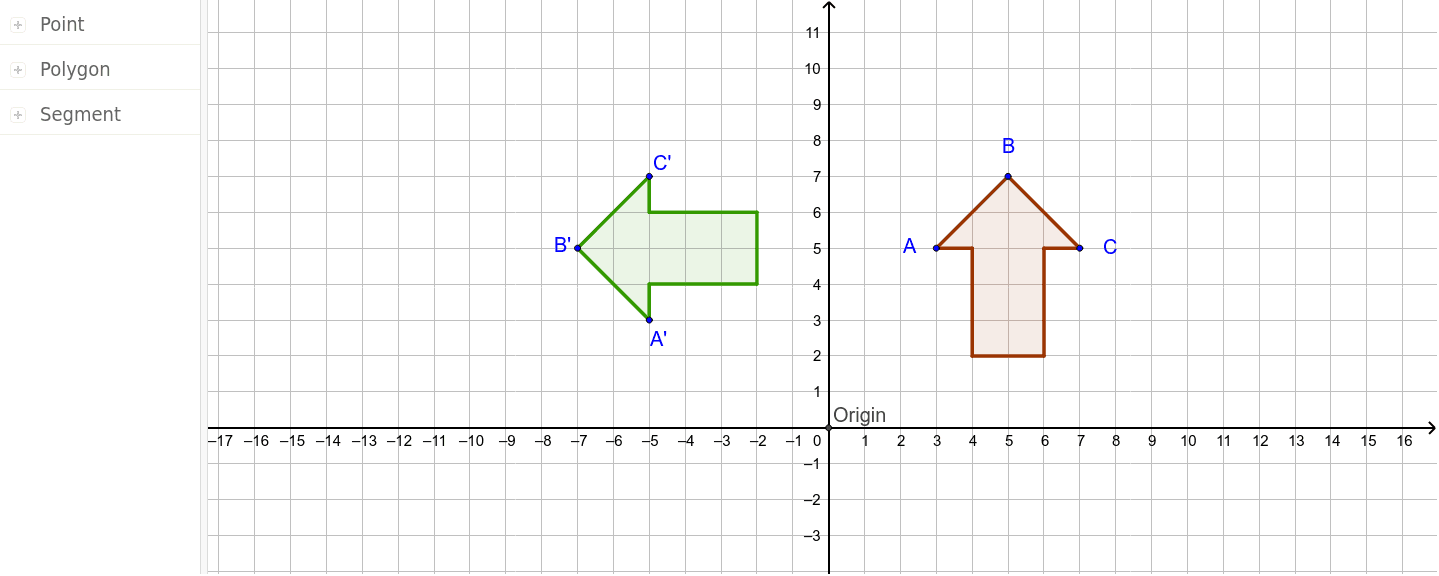
①This example demonstrates the geometric transformation of a polygon (poly1) and all its vertices, edges, and interior points rotated 90 degrees counterclockwise about the origin, clearly showing the correspondence between the original and rotated figures. ②The core mathematical concept is the rotation transformation in plane geometry, involving the center of rotation (origin), the angle of rotation (90 degrees), and the property that rotation preserves shape and size, while also relating to vectors, functions, and cosine. ③Construction highlights: Using GeoGebra commands such as Segment, Polygon, Intersect, and Rotate, the original figure (points A, B, C, D, E, F, G and segments a, b, c, d, e, f, g) and the rotated figure (objects with primes) are constructed, with Origin as the rotation center. ④This is suitable for middle school mathematics teaching on geometric transformations, helping students understand the geometric meaning of rotation, coordinate change rules, and serving as a dynamic demonstration tool for intuitive learning.
GeoGebra Commands & Parameters
Segment(A, B) → aSegment(B, C) → bSegment(C, F) → cSegment(F, D) → dSegment(D, E) → eSegment(E, G) → fSegment(G, A) → gPolygon(G, A, B, C, F, D, E) → poly1, g_1, a_1, b_1, c_1, f_1, d_1, e_1Intersect(xAxis, yAxis) → OriginRotate(G, 90*°, Origin) → G'Rotate(A, 90*°, Origin) → A'Rotate(B, 90*°, Origin) → B'Rotate(C, 90*°, Origin) → C'Rotate(F, 90*°, Origin) → F'Rotate(D, 90*°, Origin) → D'Rotate(E, 90*°, Origin) → E'Polygon(G', A', B', C', F', D', E') → poly1', g', a', b', c', f', d', e'
AI Drawing Prompt Reference
In a coordinate plane with the origin as the center, first draw a polygon with seven vertices connected in order by line segments, forming a closed shape. Then rotate each vertex of this polygon 90 degrees counterclockwise around the origin, obtaining new corresponding vertices. Connect these new vertices in the same order to form the rotated polygon. Show both the original and rotated polygons clearly, demonstrating that rotation preserves shape and size while changing position.
The prompt above was compiled from the original drawing commands and is for reference only.