
Rotating Trapezoid: Dynamic Geometry Demonstration
Loading the math board and drawing, please wait…
In collections
Rotating 2D shapes to make 3D Shapes
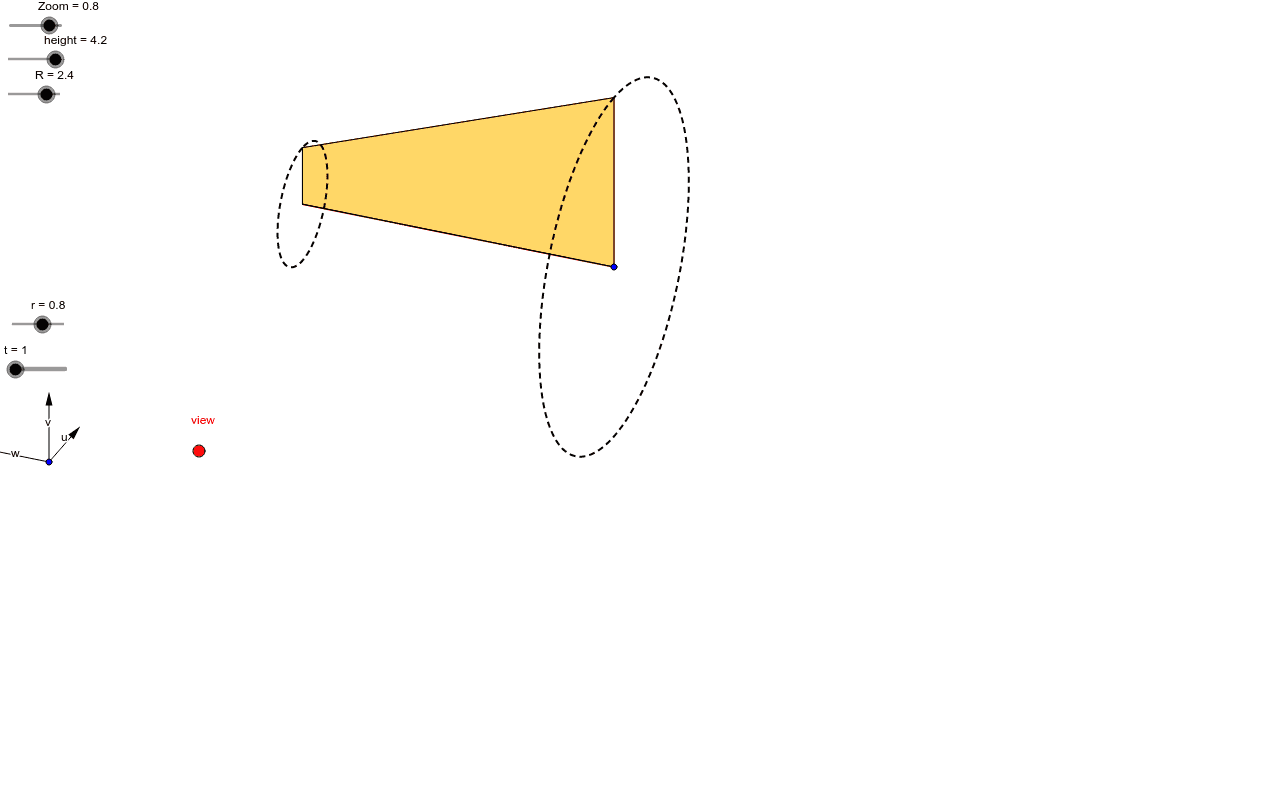
① This GeoGebra example dynamically demonstrates the rotation of a trapezoid around an axis, visually showing the formation of a solid of revolution (such as a frustum or similar shape). ② Core mathematical concepts include solids of revolution, integral calculus (for volume computation), linear functions (defining the trapezoid's sides), vectors and coordinate transformations, along with equilateral triangles and fractions as foundational geometry and algebra topics. ③ Construction highlights: uses Vector to define rotation direction, OrthogonalLine to construct perpendiculars, Sequence to generate point series, Translate for shifting, CurveCartesian for parametric curves, and Polygon/Segment to build the trapezoid and auxiliary shapes; key objects include B_1, view, xa, sinphi, cosphi, ya, sintheta, Zoom, xy, g, X, u, k, costheta, Y, v, a_1, b, c, Z, w, R, height, n, B, liste3, t, B', r, liste7, liste8, a, h, poly3, b_1, b', c_1, d_1, h_1, speed, with a slider controlling rotation speed. ④ Suitable for high school or early college students to understand revolution solids, integral applications, and dynamic geometric construction; also useful for classroom demonstrations.
GeoGebra Commands & Parameters
Vector(B_1, X) → uVector(B_1, Y) → vOrthogonalLine(view, yAxis) → a_1OrthogonalLine(view, xAxis) → bVector(B_1, Z) → wSequence((x(B), y(B)) - (R * (((sin(0°) * sin(i°)) * w) + ((cos(0°) * sin(i°)) * u) - (cos(i°) * v))), i, 0, k, n) → liste3Translate(B, Vector[(height * w)]) → B'Sequence((x(B'), y(B')) - (r * (((sin(0°) * sin(i°)) * w) + ((cos(0°) * sin(i°)) * u) - (cos(i°) * v))), i, 0, k, n) → liste7Sequence(Polygon[B, Element[liste3, i], Element[liste7, i], B'], i, 0, t) → liste8CurveCartesian(x(B - (R * (((0 * sin(i)) * w) + (sin(i) * u) - (cos(i) * v)))), y(B - (R * (((0 * sin(i)) * w) + (sin(i) * u) - (cos(i) * v)))), i, 0, 6.283185307179586) → aCurveCartesian(x(B' - (r * (((0 * sin(i)) * w) + (sin(i) * u) - (cos(i) * v)))), y(B' - (r * (((0 * sin(i)) * w) + (sin(i) * u) - (cos(i) * v)))), i, 0, 6.283185307179586) → hPolygon(B, B', Element[liste7, t], Element[liste3, t]) → poly3, b_1, b', c_1, d_1Segment(B', B) → h_1