
Rotating Star Example
Loading the math board and drawing, please wait…
In collections
Rotations
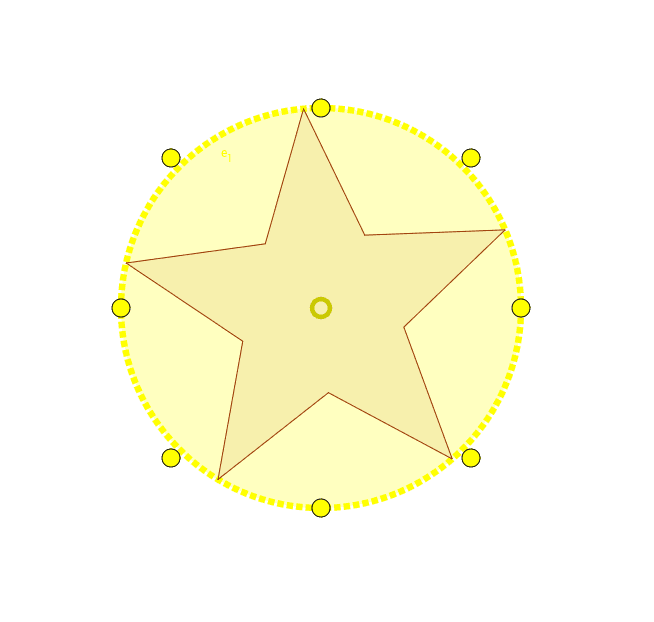
This example demonstrates a dynamic rotating star pattern. It involves core mathematical concepts like polygon construction, angle calculation, and geometric transformations. The construction uses GeoGebra commands Polygon, Circle, and objects such as s0, α, n, p2, etc., controlled by sliders for rotation and shape variation. Suitable for middle school and above students to learn geometric construction and dynamic demonstrations.
GeoGebra Commands & Parameters
Polygon(t * A0, t * A1, t * A2, t * A3, t * A4) → Vieleck1, a, b, c, d, ePolygon(s * B0, s * B1, s * B2, s * B3, s * B4) → Vieleck2, f, g, h, i, jPolygon(t * A0, s * B0, t * A1, s * B1, t * A2, s * B2, t * A3, s * B3, t * A4, s * B4) → Vieleck3, k, d_1, l, m, p, q, r, a_1, b_1, c_1Circle(A, t) → e_1
AI Drawing Prompt Reference
Draw a dynamic rotating star pattern consisting of two polygons and a circle. The first polygon is formed by five points, and the second polygon is also formed by five points. The third polygon is created by alternating the vertices of the first and second polygons. A circle is centered at a point with a radius that changes based on a parameter. The size and rotation angle of the two polygons are controlled by two sliders, forming a star pattern through alternating connections.
The prompt above was compiled from the original drawing commands and is for reference only.