
Hexagon to Square: Geometric Construction and Area Transformation
Loading the math board and drawing, please wait…
In collections
geometriadinamica.es
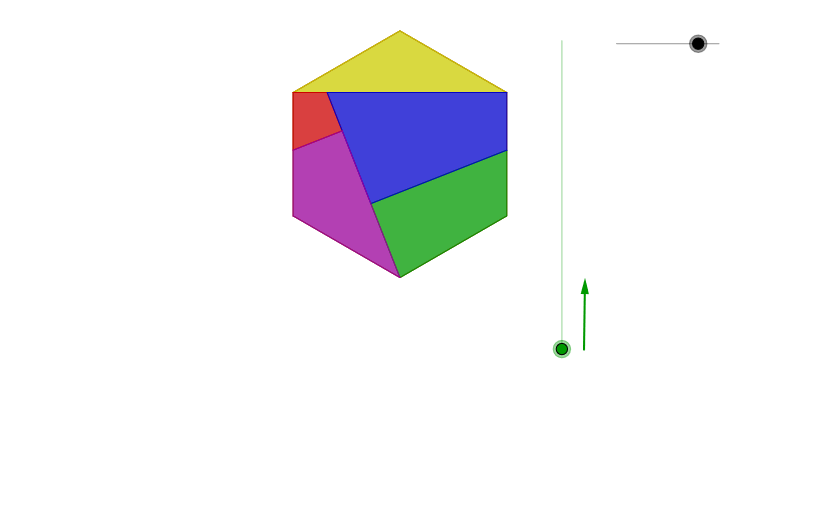
This example demonstrates the geometric construction method of transforming a hexagon into an equivalent area square. The core mathematical concepts include polygon area transformation, congruence transformations (translation, rotation, reflection), and the principles of ruler-and-compass construction. Construction details: Use the Circle command to draw auxiliary circles, find intersections with the Intersect command, perform mirror reflections with the Mirror command, implement translations via Vector and Translate, and construct the final polygon using the Polygon command. This example involves key control points A, B, C, D and multiple auxiliary points. It is suitable for middle school and above students to understand geometric transformation concepts, and can serve as a demonstration material for geometry construction courses to develop logical reasoning and spatial imagination skills.
GeoGebra Commands & Parameters
Mirror(B, A) → ECircle(B, A) → dCircle(A, B) → cIntersect(d, c, 2) → CMirror(C, A) → GIntersect(d, c, 1) → DMirror(D, A) → FPolygon(C, B, D, G, E, F) → P, c_1, b, d_1, g, e_1, fCircle(E, h) → kPolygon(B, C, D) → Q, d_2, b_1, c_2Intersect(k, b_1, 1) → IVector(B, B + (a4 * (F - B))) → uTranslate(B, u) → B'Translate(C, u) → C'Translate(D, u) → D'Polygon(B', C', D') → Q', d', b', c'Segment(I, E) → iSegment(B, F) → jIntersect(i, j) → JOrthogonalLine(J, i) → lIntersect(l, f) → KPolygon(C, I, J, K) → R, c_3, i_1, j_1, k_1Vector(I, I + (a2 * (E - I))) → vTranslate(C, v) → C'_1Translate(I, v) → I'Translate(J, v) → J'Translate(K, v) → K'Polygon(C'_1, I', J', K') → R', c'_1, i', j', k'OrthogonalLine(K, f) → mIntersect(m, d_1) → LOrthogonalLine(L, i) → nIntersect(n, i) → MPolygon(M, L, G, E) → S, m_1, l_1, g_1, e_2Vector(G, G + (a1 * (F - G))) → wTranslate(M, w) → M'Translate(L, w) → L'Translate(G, w) → G'Translate(E, w) → E'Polygon(M', L', G', E') → S', m', l', g', e'Polygon(I, D, L, M) → T, i_2, d_3, l_2, m_2Vector(I, I + (a3 * (H - I))) → u_1Translate(I, u_1) → I'_1Translate(D, u_1) → D'_1Translate(L, u_1) → L'_1Translate(M, u_1) → M'_1Polygon(I'_1, D'_1, L'_1, M'_1) → T', i'_1, d'_1, l'_1, m'_1Polygon(K, J, E, F) → U, k_2, j_2, e_3, f_1Vector(N, O) → z
AI Drawing Prompt Reference
Draw a regular hexagon and demonstrate its area-preserving transformation into a square. Start by constructing two auxiliary circles centered at adjacent vertices with equal radii, find their intersection points and mirror images, then connect these points to form the hexagon. Next, create a triangle and use translations, rotations, and reflections to partition the hexagon into several polygons, including parallelograms, trapezoids, and triangles, which are then rearranged into an equivalent square. Include auxiliary circles, intersection points, translation vectors, perpendicular lines, and the transformed polygons to clearly illustrate the geometric principle of area conservation.
The prompt above was compiled from the original drawing commands and is for reference only.