
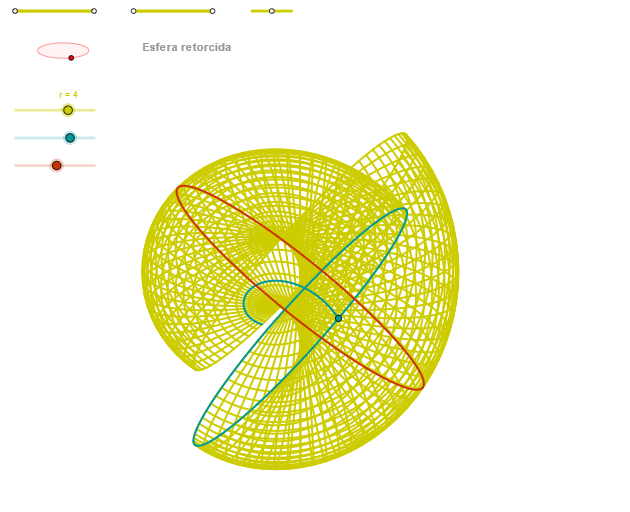
Rotated Ellipsoid Construction Example
Loading the math board and drawing, please wait…
In collections
geometriadinamica.es
This example demonstrates constructing a rotated ellipsoid using GeoGebra. Key mathematical concepts include geometric transformations, conic sections, and solid geometry. Construction involves commands like Segment, Point, OrthogonalLine, Circle, Intersect, Ellipse, and Sequence. Suitable for high school students or college undergraduates learning geometric construction and coordinate geometry.
GeoGebra Commands & Parameters
Segment(Q5, Q6) → p5Point(p5) → P5Segment(Q3, Q4) → p2Point(p2) → P3Segment(P3, Q4) → p4Point(p4) → P4Segment(Q1, Q2) → p1Point(p1) → P1Segment(P1, Q2) → p3Point(p3) → P2OrthogonalLine(C, xAxis) → zz2Circle(C, 0.62) → zz0Intersect(zz0, zz2, 1) → ZZ4Intersect(zz0, zz2, 2) → ZZ3Ellipse(ZZ3, ZZ4, 0.65) → zElipse2Point(zElipse2) → ZIntersect(zElipse2, zz2) → ZZ7, ZZ8Angle(ZZ8, C, Z) → zAngIncOrthogonalLine(C, yAxis) → zz1Intersect(zz0, zz1, 2) → ZZ2Intersect(zz0, zz1, 1) → ZZ1Ellipse(ZZ1, ZZ2, 0.65) → zElipse1Point(zElipse1) → XYIntersect(zElipse1, zz1) → ZZ5, ZZ6Angle(ZZ6, C, XY) → zAngRotSegment(ZZ5, ZZ6) → zz4Segment(ZZ7, ZZ8) → zz3Intersect(zElipse2, zElipse1, 1) → zPunto1Intersect(zElipse2, zElipse1, 4) → zPunto2Segment(zPunto1, zPunto2) → zSeg2CurveCartesian((r * (((cos(u) * cos(α)) * sin(zAngRot)) + ((sin(u) * cos(α)) * cos(zAngRot)))), (r * (((((-cos(u)) * cos(α)) * cos(zAngRot)) * sin(zAngInc)) + (((sin(u) * cos(α)) * sin(zAngRot)) * sin(zAngInc)) + ((sin(α) + (0.7 * u)) * cos(zAngInc)))), u, u1, u2) → curva2CurveCartesian(((r * cos(v)) * sin(zAngRot)), (r * ((((-cos(v)) * cos(zAngRot)) * sin(zAngInc)) + (sin(v) * cos(zAngInc)))), v, v1, v2) → curva1CurveCartesian((r * (((cos(β) * cos(v)) * sin(zAngRot)) + ((sin(β) * cos(v)) * cos(zAngRot)))), (r * (((((-cos(β)) * cos(v)) * cos(zAngRot)) * sin(zAngInc)) + (((sin(β) * cos(v)) * sin(zAngRot)) * sin(zAngInc)) + ((sin(v) + (0.7 * β)) * cos(zAngInc)))), v, v1, v2) → a1Sequence(CurveCartesian[(r * (((cos(u) * cos(v)) * sin(zAngRot)) + ((sin(u) * cos(v)) * cos(zAngRot)))), (r * (((((-cos(u)) * cos(v)) * cos(zAngRot)) * sin(zAngInc)) + (((sin(u) * cos(v)) * sin(zAngRot)) * sin(zAngInc)) + ((sin(v) + (0.7 * u)) * cos(zAngInc)))), v, v1, v2], u, u1, u2, paso) → list2Sequence(CurveCartesian[(r * (((cos(u) * cos(v)) * sin(zAngRot)) + ((sin(u) * cos(v)) * cos(zAngRot)))), (r * (((((-cos(u)) * cos(v)) * cos(zAngRot)) * sin(zAngInc)) + (((sin(u) * cos(v)) * sin(zAngRot)) * sin(zAngInc)) + ((sin(v) + (0.7 * u)) * cos(zAngInc)))), u, u1, u2], v, v1, v2, paso) → list1
AI Drawing Prompt Reference
Draw a rotated ellipsoid centered at the origin. Construct two perpendicular axes, one along the x-axis and one along the y-axis, with an ellipse placed on each axis, its major axis aligned with the corresponding axis. The two ellipses intersect at two points, connected by a segment. Then generate a family of surface curves using parametric equations, forming a grid in two directions, and add a helical auxiliary curve to show the rotation. The final figure consists of these curves and intersection points, illustrating the 3D rotated ellipsoid shape.
The prompt above was compiled from the original drawing commands and is for reference only.