
Rods N Cubes Addition: Visualizing 3D Vectors and Volume
Loading the math board and drawing, please wait…
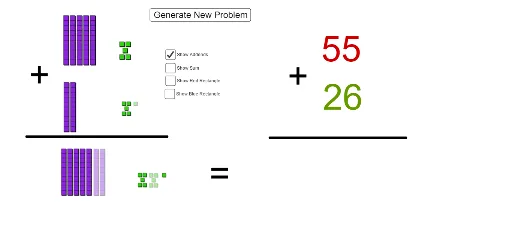
This GeoGebra example demonstrates the 'Rods N Cubes Addition' construction, combining randomly generated rods (segments) with cubes to visualize addition operations and volume in three-dimensional space. Core mathematical concepts include 3D vectors, polygons, volume, and random generation in probability. The construction uses the Random command to generate points A, B, etc., Segment to create rods, Polygon to build faces, and numerous named objects (pic1 to pic10) with auxiliary points (C to Z, A_1 to D_1) to assemble the complex 3D composition. Suitable for high school or early university students to explore vector addition, solid geometry, and volume, as well as an interdisciplinary link between probability and geometry.
GeoGebra Commands & Parameters
Random(1, 5) → nRandom(1, 9) → iRandom(1, 4) → jRandom(1, 9) → kSegment(F_4, Q_5) → hSegment(R_5, S_5) → lPolygon(N_6, O_6, P_6, Q_6) → poly1, n_6, o_6, p_6, q_6Polygon(N_7, O_7, P_7, Q_7) → poly1_1, n_1, o_1, p_1, q_1
AI Drawing Prompt Reference
Create a 3D model to visualize vector addition and volume. First, generate 5 random integers between 1 and 5, then generate 9 random integers between 1 and 9. Use these random points to create two segments, and then create two polygons with four points each. Finally, assemble these segments and polygons into a complex 3D structure.
The prompt above was compiled from the original drawing commands and is for reference only.