
Rigid Motion Assessment Review
Loading the math board and drawing, please wait…
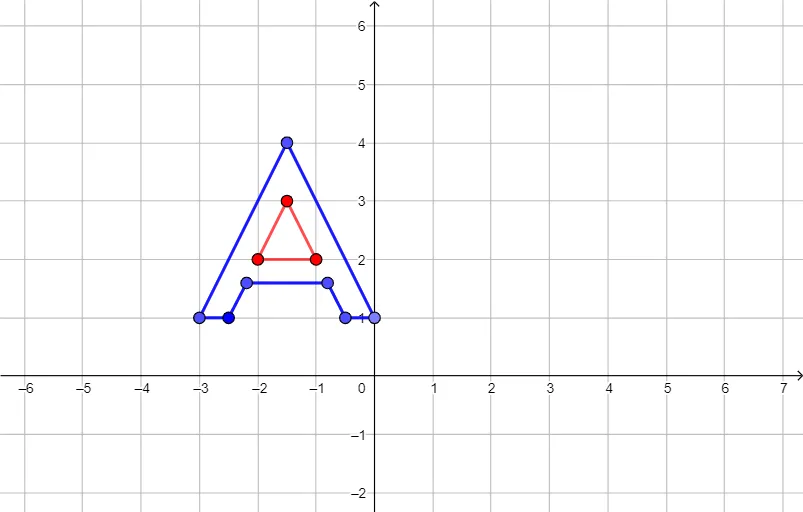
This example demonstrates the application of rigid motions (reflection, rotation, translation) in plane figures. It involves core math concepts like rigid transformations, coordinate geometry, and polygon construction. The construction uses commands such as Polygon, Point, Segment and objects like A, B, C, D. Suitable for high school mathematics teaching to review and reinforce rigid motion knowledge.
GeoGebra Commands & Parameters
Polygon(A, B, D, C) → q1, a, b, d, cPoint(c) → EPoint(b) → FSegment(E, F) → fPoint(f) → HSegment(G, H) → gPoint(yAxis) → ISegment(I, J) → hSegment(J, K) → iSegment(M, L) → jSegment(L, N) → kSegment(N, M) → lSegment(Q, R) → qSegment(R, I) → rSegment(Q, O) → mSegment(O, P) → nSegment(P, K) → pPolygon(K, J, I, R, Q, O, P) → poly1, k_1, j_1, i_1, r_1, q_1, o, p_1
AI Drawing Prompt Reference
Draw a quadrilateral formed by points A, B, C, and D, labeled as q1. Then draw a segment from C to D, labeled as f. From the endpoint of f, draw a segment to B, labeled as g. Draw a segment from a point on the y-axis to I, labeled as h. Then draw a segment from I to J, labeled as i. From J, draw a segment to K, labeled as j. From K, draw a segment to L, labeled as k. From L, draw a segment to N, labeled as l. From N, draw a segment to M, labeled as m. From M, draw a segment to O, labeled as n. From O, draw a segment to P, labeled as p. Finally, draw a hexagon formed by points K, J, I, R, Q, O, and P, labeled as poly1.
The prompt above was compiled from the original drawing commands and is for reference only.