
Right Triangle Similarity
Loading the math board and drawing, please wait…
In collections
Unit 9: Right Triangles and Trigonometry
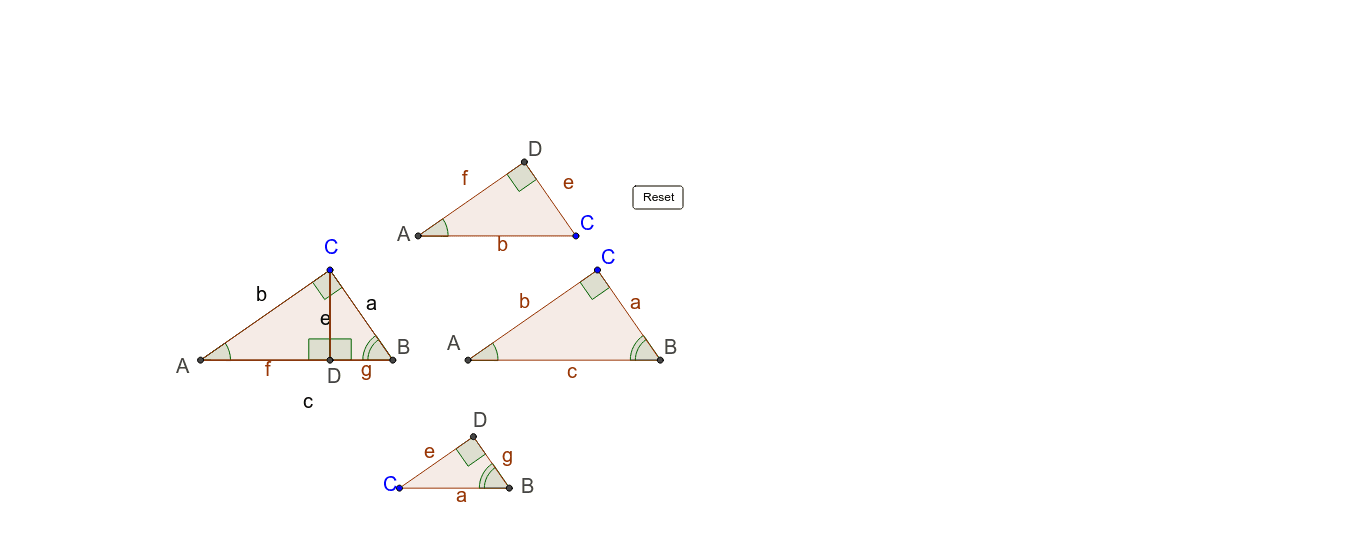
This example demonstrates the concept of similarity in right triangles. By constructing right triangles and their similar counterparts, it illustrates the properties of similar triangles. It uses commands such as Line, Intersect, OrthogonalLine, Segment, Polygon, Ray, Vector, Translate, Angle, AngularBisector, Rotate, Midpoint, Mirror in GeoGebra. Suitable for middle school and above students to learn about similar triangles.
GeoGebra Commands & Parameters
Line(PP, C) → a_1Intersect(a_1, xAxis) → AOrthogonalLine(C, a_1) → b_1Intersect(b_1, xAxis) → BSegment(C, A) → bSegment(C, B) → aSegment(A, B) → cOrthogonalLine(C, c) → dIntersect(d, c) → D_1Segment(C, D_1) → ePolygon(C, D_1, B) → poly1, b_2, c_1, d_1Polygon(C, D_1, A) → poly2, a_2, c_2, d_2Ray(A, C) → fRay(A, B) → gRay(C, B) → hVector(A, C') → uTranslate(C, u) → C'_1Translate(D_1, u) → D'Translate(A, u) → A'Polygon(C'_1, D', A') → poly2', a', c'_1, d'Vector(C, B') → vTranslate(C, v) → C'_2Translate(D_1, v) → D'_1Translate(B, v) → B'_1Polygon(C'_2, D'_1, B'_1) → poly1', b'_1, c'_2, d'_1Polygon(A, C, B) → poly3, b_3, a_3, c_3Vector(A, AA) → wTranslate(A, w) → A'_1Translate(C, w) → C'_3Translate(B, w) → B'_2Polygon(A'_1, C'_3, B'_2) → poly3', b'_2, a'_1, c'_3Angle(A'_1, C'_3, B'_2) → αAngle(B'_2, A'_1, C'_3) → βAngle(C'_3, B'_2, A'_1) → γAngle(C, B, A) → δAngularBisector(A', C'_1, D') → jAngularBisector(C'_1, D', A') → kIntersect(j, k) → ERotate(C'_1, (n * (180° - β)), E) → FRotate(D', (n * (180° - β)), E) → D''Rotate(A', (n * (180° - β)), E) → A''Polygon(F, D'', A'') → poly2'', a'', f_1, d''AngularBisector(D'_1, C'_2, B'_1) → lAngularBisector(C'_2, B'_1, D'_1) → mIntersect(l, m) → GAngle(A'_1, B, C) → εRotate(C'_2, (-((n * ε))), G) → HRotate(D'_1, (-((n * ε))), G) → DRotate(B'_1, (-((n * ε))), G) → JPolygon(H, D, J) → poly1'', j_1, h_1, i_1Midpoint(d'') → IMidpoint(i_1) → KOrthogonalLine(I, d'') → pOrthogonalLine(K, i_1) → qMirror(F, p) → F'Mirror(D'', p) → D'''Mirror(A'', p) → A'''Polygon(F', D''', A''') → poly2''', a''', f', d'''Mirror(H, q) → H'Mirror(D, q) → D'_2Mirror(J, q) → J'Polygon(H', D'_2, J') → poly1''', j', h', d'_2Angle(A, C, B) → ζAngle(C'_1, D', A') → ηAngle(B'_1, D'_1, C'_2) → θAngle(D_1, A, C) → ιAngle(D', A', C'_1) → κSegment(A, D_1) → rSegment(D_1, B) → sAngle(D'', A'', F) → λAngle(F, D'', A'') → μAngle(C, D_1, A) → νAngle(B, D_1, C) → ξAngle(A''', D''', F') → οAngle(F', A''', D''') → ρAngle(C'_2, B'_1, D'_1) → σAngle(J, D, H) → τAngle(H, J, D) → υAngle(H', D'_2, J') → ϕAngle(D'_2, J', H') → χ
AI Drawing Prompt Reference
Draw a right triangle ABC with C as the right angle. Construct a perpendicular line from C to AB, intersecting at D. Connect CD, AB, and BC to form two right triangles. Then, translate and rotate triangle ABC to create similar triangles A'B'C' and A''B''C''. Label angles α, β, γ, and δ. Finally, find the intersection points of the angle bisectors of triangles A'B'C' and A''B''C'', rotate to get new triangle F'D'A''.
The prompt above was compiled from the original drawing commands and is for reference only.