
Rhombus, Trapezoid, Square: Geometric Construction and Measurement
Loading the math board and drawing, please wait…
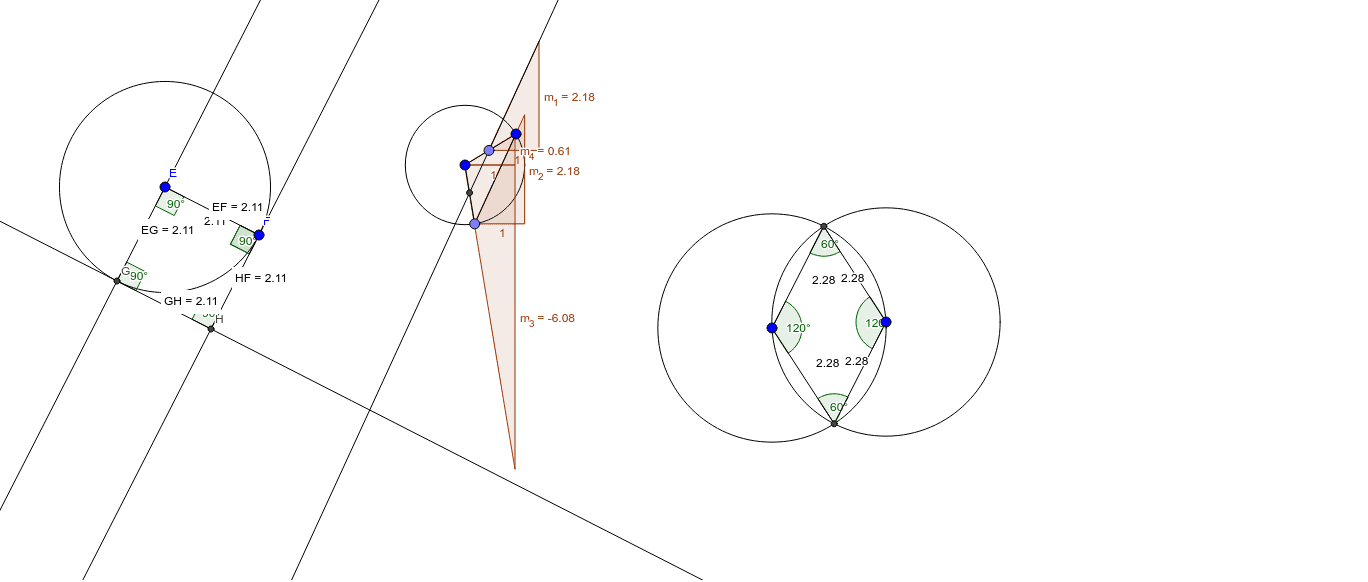
This GeoGebra example dynamically illustrates the geometric relationships among a rhombus, a trapezoid, and a square. It demonstrates how these quadrilaterals can be constructed and analyzed using core commands such as Circle, Intersect, Segment, Angle, OrthogonalLine, Distance, Point, Line, and Slope. The construction involves creating circumcircles, measuring distances between vertices, labeling angles, and computing slopes to explore properties like side lengths, angle sums, and symmetry. Key mathematical concepts include polygon classification, angle relationships, distance measurement, arithmetic mean, and geometric transformations. This resource is ideal for middle and high school geometry classes, helping students visualize quadrilateral properties, practice construction techniques, and understand how transformations affect shape attributes.
GeoGebra Commands & Parameters
Circle(B, C) → dCircle(C, B) → cIntersect(d, c, 2) → AIntersect(d, c, 1) → DSegment(C, A) → aSegment(A, B) → bSegment(B, D) → eSegment(D, C) → fAngle(A, B, D) → αAngle(D, C, A) → βAngle(C, A, B) → γAngle(B, D, C) → δCircle(E, F) → gSegment(E, F) → hOrthogonalLine(E, h) → iIntersect(g, i, 1) → GOrthogonalLine(G, i) → jOrthogonalLine(F, j) → kIntersect(j, k) → HDistance(i, h) → lDistance(j, k) → mAngle(G, E, F) → εAngle(E, F, H) → ζAngle(H, G, E) → ηAngle(E, F, H) → θAngle(F, H, G) → ιDistance(G, H) → distanceGHDistance(H, F) → distanceHFDistance(E, G) → distanceEGDistance(E, F) → distanceEFCircle(I, J) → pPoint(p) → KSegment(I, K) → nSegment(I, J) → qSegment(K, J) → rPoint(q) → LLine(L, r) → sIntersect(s, n) → MSlope(s) → m_1Slope(r) → m_2Slope(n) → m_3Slope(q) → m_4
AI Drawing Prompt Reference
Draw a rhombus, a trapezoid, and a square by constructing circles, finding intersections, drawing line segments, and measuring angles. Start by drawing the diagonals of the rhombus, then use their intersection to form the trapezoid. Finally, measure distances and angles to determine the side lengths and angles of the square. Note that the diagonals of the rhombus are perpendicular and bisect each other, one pair of the trapezoid's sides are parallel, and all sides of the square are equal with each angle being 90 degrees.
The prompt above was compiled from the original drawing commands and is for reference only.