
Rhombus Properties by Simon
Loading the math board and drawing, please wait…
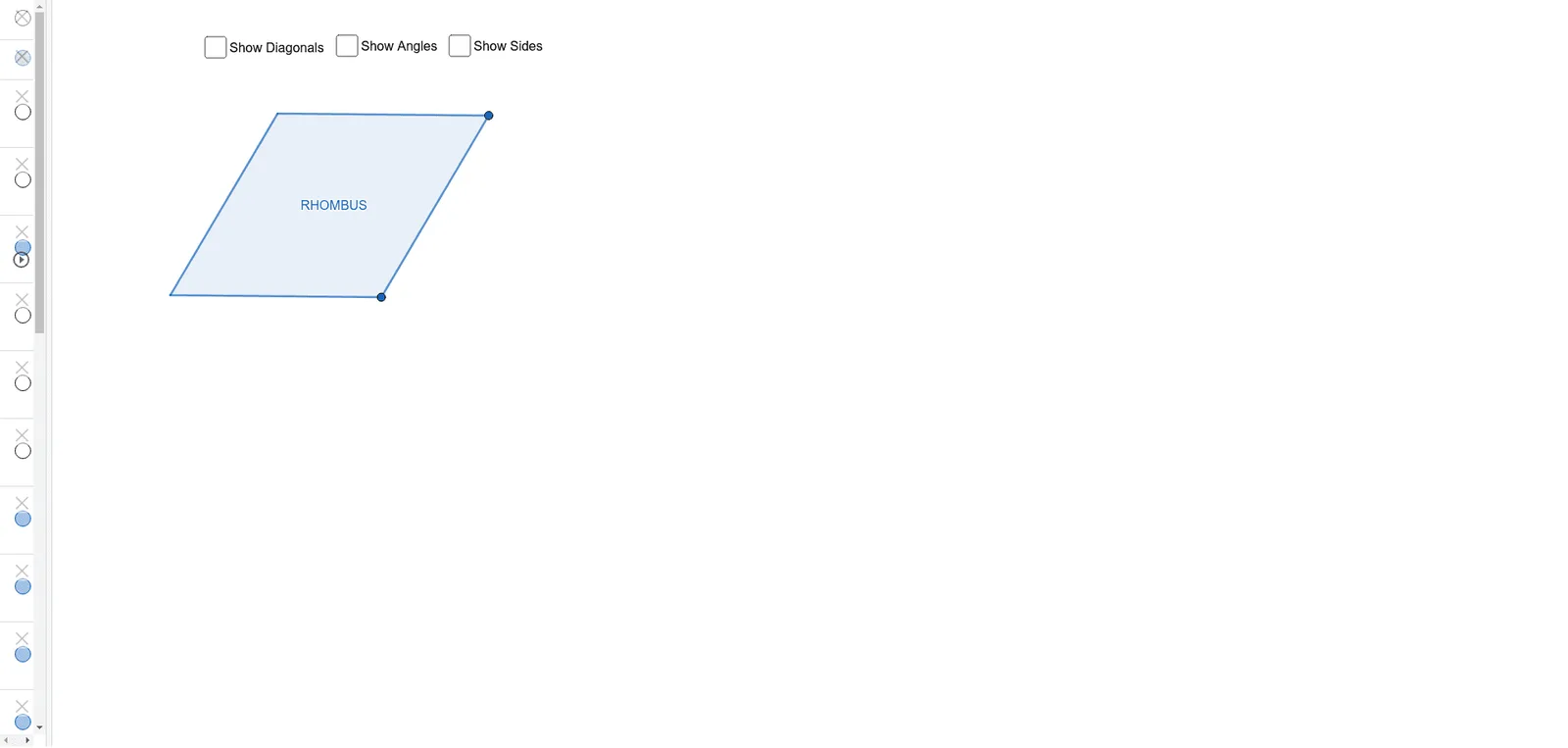
This example demonstrates the properties of a rhombus. Key mathematical concepts include the definition of a rhombus, properties of diagonals, and area calculation. Using GeoGebra commands such as Line, LineBisector, Point, and Intersect, a rhombus is constructed and its properties are observed. Suitable for middle school and above students learning geometric construction.
GeoGebra Commands & Parameters
Line(A, B) → fLineBisector(B, A) → gPoint(g) → CIntersect(f, g) → DCircle(D, C) → cIntersect(c, g, 2) → EPolygon(A, C, B, E) → q1, a, c_1, b, eSegment(A, B) → hSegment(E, C) → iAngle(B, E, A) → αAngle(E, A, C) → βAngle(A, C, B) → γAngle(C, B, E) → δSegment(A, C) → jSegment(E, B) → kSegment(E, A) → lSegment(B, C) → m
AI Drawing Prompt Reference
Draw a rhombus, label its diagonals and show their intersection point, then draw a circle centered at the intersection point that intersects the diagonals again. Connect these four points to form the rhombus, measure and label the sizes of the three interior angles, and finally connect the endpoints of the diagonals to the intersection point to form two perpendicular segments.
The prompt above was compiled from the original drawing commands and is for reference only.