
Rhombus Project: Dynamic Construction and Geometric Properties
Loading the math board and drawing, please wait…
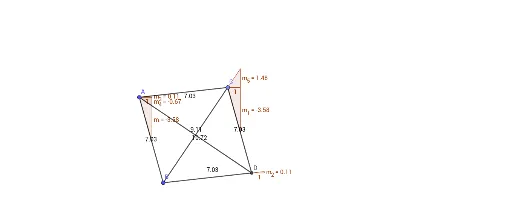
① This GeoGebra example dynamically demonstrates the construction of a rhombus, showing how to generate a standard rhombus using circles, segments, and intersection points, and observe relationships among sides, diagonals, and angles. ② Core mathematical concepts include the definition of a rhombus (all sides equal), perpendicular bisecting diagonals, symmetry, and fundamental principles of geometric construction. ③ Construction highlights: Based on the construction summary, commands such as Segment, Circle, Point, Line, Intersect, and Slope are used, with objects A, B, f, c, C, g, h, i, D, j, k, m, m_1, m_2, m_3, l, n, m_4, m_5. Vertices are determined via intersections of circles and lines, then connected to form the rhombus, possibly with slope measurements to verify properties. ④ Suitable for middle school geometry or high school analytic geometry introduction, useful for intuitively understanding rhombus properties and dynamic geometric construction methods, as well as basic GeoGebra operation practice.
GeoGebra Commands & Parameters
Segment(A, B) → fCircle(A, B) → cPoint(c) → CSegment(A, C) → gLine(C, f) → hLine(B, g) → iIntersect(h, i) → DSegment(C, D) → jSegment(D, B) → kSlope(f) → mSlope(j) → m_1Slope(k) → m_2Slope(g) → m_3Segment(C, B) → lSegment(A, D) → nSlope(n) → m_4Slope(l) → m_5