
Rhombus Exploration: Geometric Construction and Properties
Loading the math board and drawing, please wait…
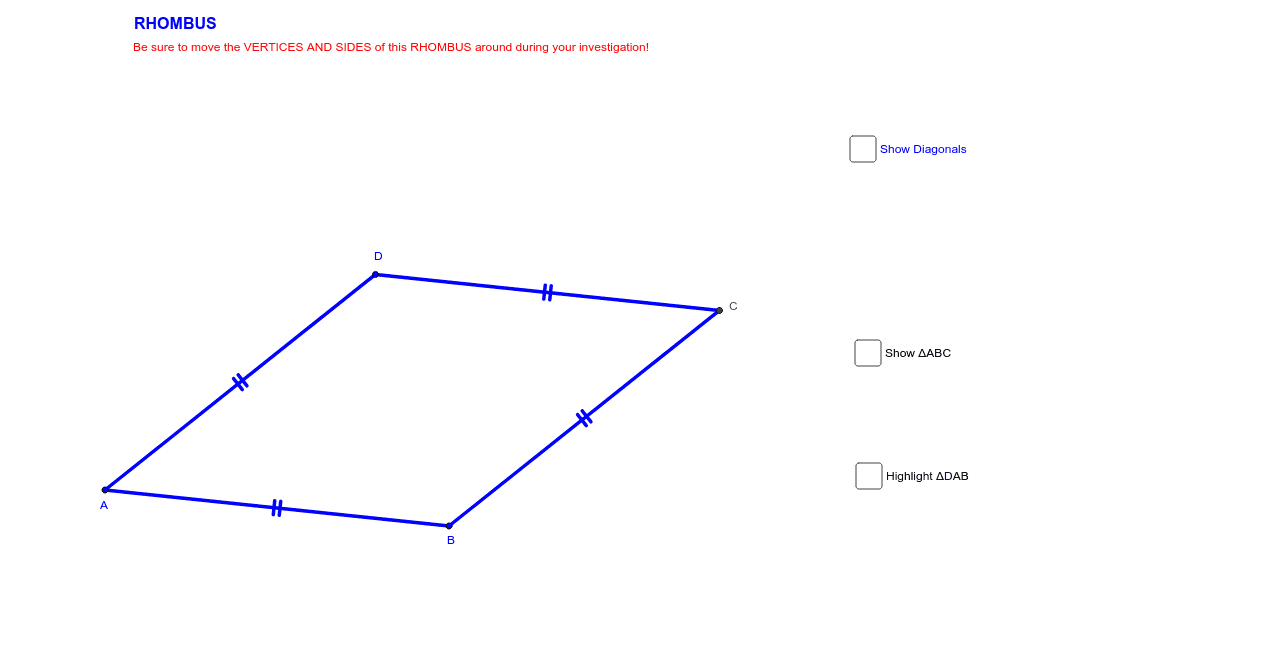
①This GeoGebra example dynamically demonstrates the construction of a rhombus and explores its geometric properties such as sides, angles, and diagonals through symmetry and transformations. ②Core mathematical concepts include the definition of a rhombus (all sides equal), perpendicular bisecting diagonals, symmetry, triangle congruence and similarity, and polygon angle sums. ③Construction highlights: using commands like Circle, Point, Intersect, Segment, Midpoint, Angle, Polygon, and Mirror, the construction involves objects A, B, c, D, d, e, C, a, b, f, g, text1, E, h, i, j, k, l, α, β, γ, δ, ε, ζ, η, θ, ι, m, n, text3_1, poly1, c_1, a_1, b_1, o, A', B', C', poly1', c', etc., allowing interactive observation of changes. ④Suitable for middle school geometry lessons, math lab activities, or self-study, helping students intuitively understand rhombus properties and geometric transformations, and useful for teachers creating dynamic courseware.
GeoGebra Commands & Parameters
Circle(A, B) → cPoint(c) → DCircle(B, A) → dCircle(D, A) → eIntersect(d, e, 2) → CSegment(A, B) → aSegment(B, C) → bSegment(C, D) → fSegment(D, A) → gMidpoint(A, C) → ESegment(D, E) → hSegment(E, B) → iSegment(C, E) → jSegment(E, A) → kAngle(D, C, E) → αAngle(E, C, B) → βAngle(B, A, E) → γAngle(E, A, D) → δAngle(C, B, E) → εAngle(E, B, A) → ζAngle(E, D, C) → ηAngle(A, D, E) → θAngle(C, E, D) → ιPolygon(A, B, C) → poly1, c_1, a_1, b_1Mirror(A, k) → A'Mirror(B, k) → B'Mirror(C, k) → C'Polygon(A', B', C') → poly1', c', a', b'Polygon(D, A, B) → poly2, b_2, d_1, a_2Mirror(D, h) → D'Mirror(A, h) → A'_1Mirror(B, h) → B'_1Polygon(D', A'_1, B'_1) → poly2', b'_1, d', a'_1
AI Drawing Prompt Reference
Draw a rhombus by first creating a circle with one side as radius, then placing a point on it, and using intersections of circles to determine the third vertex, completing the fourth vertex. Connect all vertices to form the rhombus, then draw both diagonals and mark their intersection. Inside the rhombus, connect the intersection point to each vertex, creating eight triangles, and label all relevant angles. Finally, reflect one half of the rhombus across a diagonal to create a symmetric copy, and draw the corresponding triangles and angle labels in the mirrored part.
The prompt above was compiled from the original drawing commands and is for reference only.