
Rhombus Construction with Trigonometric and Logarithmic Functions: Isabelle Gara
Loading the math board and drawing, please wait…
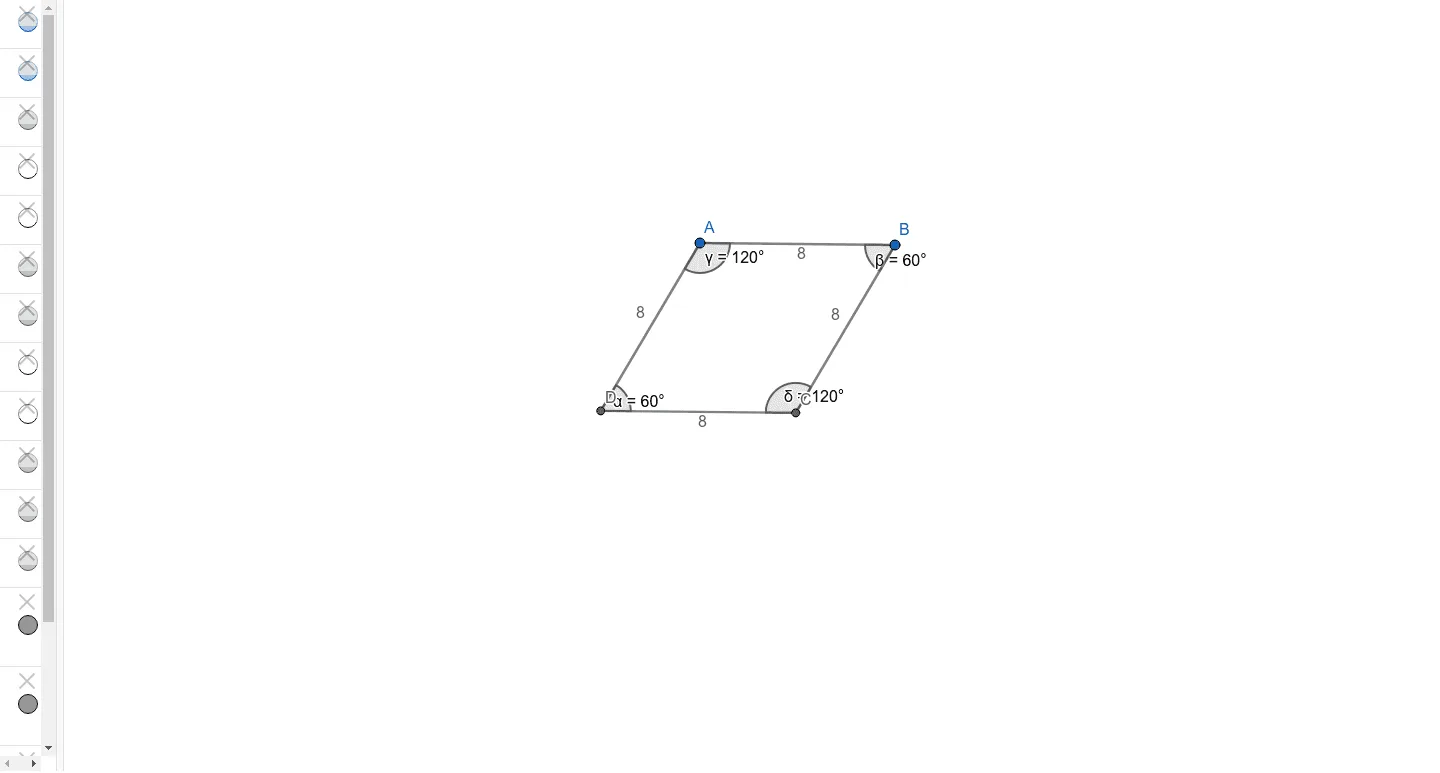
① This example demonstrates how to construct a rhombus using basic geometric elements such as circles, segments, and perpendicular bisectors, while incorporating trigonometric and logarithmic function graphs for analysis. ② Core mathematical concepts include properties of a rhombus (equal sides, perpendicular bisecting diagonals), trigonometric ratios, logarithmic functions, and angle measurement in scalene triangles. ③ Construction highlights: Based on the summary, the GeoGebra commands used are Segment, Circle, LineBisector, Intersect, Line, and Angle, creating objects A, B, f, c, g, C, h, i, j, D, k, l, and angles α, β, γ, δ. The rhombus vertices are determined via intersections of circles and perpendicular bisectors, with angles measured. ④ Suitable for middle or high school geometry and trigonometry classes, this example helps visualize rhombus construction and angle relationships, and serves as an introductory dynamic geometry exploration.
GeoGebra Commands & Parameters
Segment(A, B) → fCircle(A, B) → cLineBisector(B, A) → gIntersect(c, g, 2) → CSegment(B, C) → hLine(C, f) → iLine(A, h) → jIntersect(c, j, 2) → DSegment(A, D) → kSegment(D, C) → lAngle(A, D, C) → αAngle(C, B, A) → βAngle(B, A, D) → γAngle(B, C, D) → δ