
Rhombus Construction by bodehm.wicklund
Loading the math board and drawing, please wait…
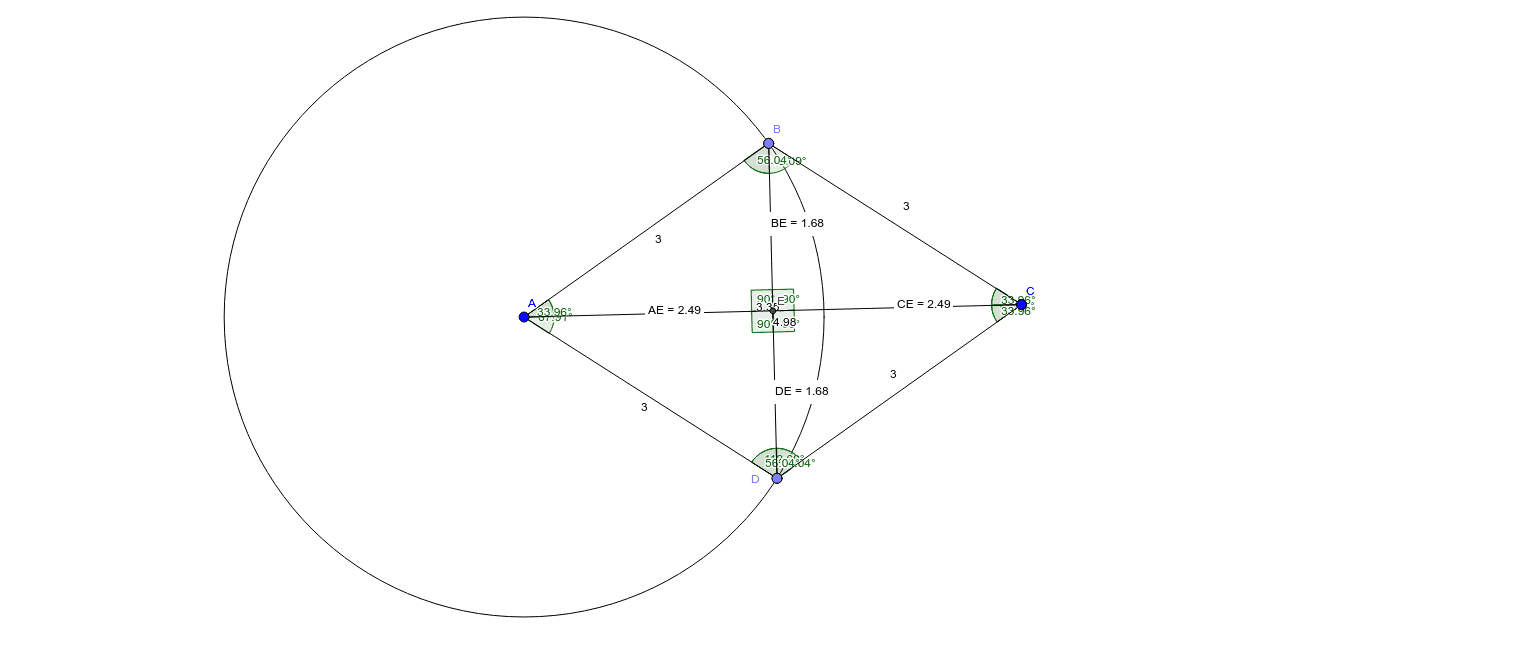
This example demonstrates the construction of a rhombus. Key mathematical concepts include the properties of a rhombus, centroid or barycenter, functions, and coordinates. Using GeoGebra commands such as Circle, Point, Segment, Mirror, etc., the rhombus is constructed and its geometric properties are explored. Suitable for middle school and above students or teachers.
GeoGebra Commands & Parameters
Circle(A, 3) → cPoint(c) → BSegment(A, B) → aPoint(c) → DSegment(A, D) → bSegment(B, D) → dMirror(A, d) → CMirror(B, d) → B'Segment(C, B') → a'Mirror(A, d) → A'_1Mirror(D, d) → C'Segment(A'_1, C') → b'Angle(A, B, C) → αAngle(C, D, A) → βAngle(B, C, D) → γAngle(D, A, B) → δSegment(A, C) → eIntersect(d, e) → EDistance(B, E) → distanceBEDistance(D, E) → distanceDEDistance(A, E) → distanceAEDistance(C, E) → distanceCEAngle(E, A, B) → εAngle(B, E, A) → ζAngle(A, B, E) → ηAngle(C, E, B) → θAngle(B, C, E) → ιAngle(E, C, D) → κAngle(C, D, E) → λAngle(E, D, A) → μAngle(D, E, C) → νAngle(A, E, D) → ξ
AI Drawing Prompt Reference
Draw a rhombus by first drawing a circle with center A and radius 3, then taking point B on the circle and connecting AB to form side a. Next, take point D on the circle and connect AD to form side b, with BD as the diagonal. Use mirroring to get points C and B', then connect BC and B'D to form sides c and d. Calculate the internal angles α, β, γ, δ, and the diagonal e and its intersection point E with the sides, measure the lengths of BE, DE, AE, and CE, and calculate the angles ε, ζ, η, θ, ι, κ, λ, μ, ν, and ξ.
The prompt above was compiled from the original drawing commands and is for reference only.