
Rhombus and Square Demonstration
Loading the math board and drawing, please wait…
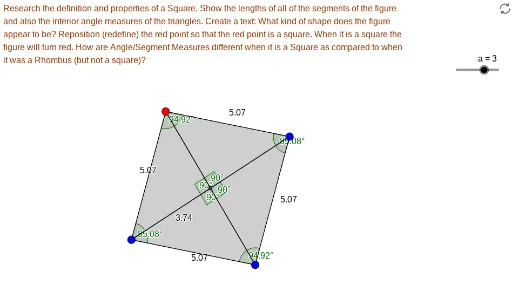
This example demonstrates the geometric properties and similarity transformations of rhombuses and squares. Key math concepts include polygons, angles, similarity transformations, and geometric constructions. The construction utilizes GeoGebra commands and objects such as Segment (line segment), Midpoint (midpoint), OrthogonalLine (perpendicular line), Line (line), LineBisector (angle bisector), Intersect (intersection), Point (point), Mirror (reflection), Polygon (polygon), Circle (circle), TableText (table text), Sum (sum), Distance (distance), InteriorAngles (interior angles), Angle (angle), and PointIn (point inside object). Suitable for middle school and above students to learn geometric transformations and polygon properties.
GeoGebra Commands & Parameters
Segment(A, B) → fMidpoint(f) → CSegment(C, B) → f_2OrthogonalLine(C, f_2) → f_3Line(M, O) → pLine(N, p) → qSegment(M, N) → mLineBisector(m) → nIntersect(n, p) → B_1OrthogonalLine(B_1, p) → j_1Intersect(q, j_1) → C_1Segment(D_1, E_1) → k_1Point(f_3) → DSegment(C, D) → gMirror(C, C) → C'Mirror(D, C) → D'Segment(C', D') → g'Polygon(A, D, B, D') → poly1, a_1, d_1, b_1, d'Polygon(E, F, G, H) → poly2, e_1, f_1, g_1, hSegment(F, H) → iLineBisector(i) → jIntersect(j, h) → KIntersect(f_1, j) → LSegment(E, G) → kLineBisector(k) → lIntersect(l, h) → IIntersect(f_1, l) → JSegment(E, F) → rPoint(p) → PPoint(q) → QIntersect(n, q) → RPolygon(M, R, N, P) → poly3, m_1, r_1, n_1, p_1Segment(Q, R) → sPoint(k_1) → SSegment(Q, M) → tPoint(Circle[S, s]) → TSegment(S, T) → h_1OrthogonalLine(S, h_1) → i_1Circle(S, t) → c_1Intersect(c_1, i_1) → U, VPolygon(S, U, T) → poly4, t_1, s_1, uIntersect(p, p_1) → WIntersect(p, poly3) → Z, A_1Polygon(M, R, C_1, B_1) → poly5, m_2, r_2, c_2, b_2Point(q) → F_1Polygon(Q, C_1, B_1, M) → poly6, q_1, c_3, b_3, m_3Polygon(M, R, N, B_1) → poly7, m_4, r_3, n_2, b_4Intersect(m_4, r_3) → G_1Intersect(r_3, n_2) → H_1Segment(A, C) → l_1Segment(I_1, J_1) → g_2Midpoint(g_2) → K_1OrthogonalLine(K_1, g_2) → h_2Point(h_2) → L_1Segment(L_1, K_1) → i_2Segment(I_1, K_1) → j_2Segment(K_1, J_1) → k_2Mirror(L_1, K_1) → M_1Mirror(K_1, K_1) → N_1Segment(M_1, N_1) → l_2Circle(K_1, J_1) → d_2OrthogonalLine(K_1, j_2) → p_2Intersect(d_2, p_2) → O_1, P_1Polygon(L_1, I_1, M_1, J_1) → poly8, l_3, i_3, m_5, j_3Polygon(Q_1, R_1, S_1, T_1) → poly9, q_2, r_4, s_2, t_2Segment(Q_1, S_1) → a_2Segment(R_1, T_1) → e_2Intersect(a_2, e_2) → U_1TableText({{A1, B1, C1, D1, E1}, {A2, B2, C2, D2, E2}, {A3, B3, C3, D3, E3}, {A4, B4, C4, D4, E4}, {A5, B5, C5, D5, E5}, {A6, B6, C6, D6, E6}, {A7, B7, C7, D7, E7}, {A8, B8, C8, D8, E8}}, "|_") → text4Sum(B2:B8) → B9Sum(C2:C8) → C9Sum(D2:D8) → D9Sum(E2:E8) → E9Sum(B9:E9) → F9Distance(a_1, l_1) → oInteriorAngles(poly1) → α, β, γ, δInteriorAngles(poly1) → ε, ζ, η, θAngle(C, C', A) → ιAngle(A, C, D') → κAngle(B, C, D) → λAngle(A, C, D) → μAngle(D', C, B) → νDistance(r_3, m_4) → vPointIn(poly7) → Pointpoly7Angle(L_1, K_1, J_1) → ξAngle(M_1, K_1, J_1) → οInteriorAngles(poly8) → ρ, σ, τ, υAngle(I_1, K_1, M_1) → ϕAngle(I_1, K_1, L_1) → χPolygon(L_1, K_1, J_1) → t1, j_4, l_4, k_3Polygon(M_1, K_1, J_1) → t2, j_5, m_6, k_4Polygon(I_1, K_1, M_1) → t3, m_7, i_4, k_5Polygon(I_1, L_1, K_1) → t4, k_6, i_5, l_5