
Similar Triangles Demo by elkane01
Loading the math board and drawing, please wait…
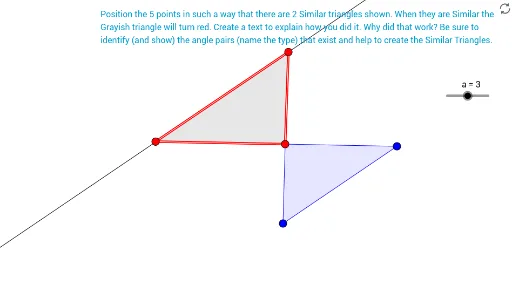
This example demonstrates the properties and criteria of similar triangles, visually showing the relationships of corresponding equal angles and proportional sides through dynamic geometry. It involves core math concepts like similarity criteria, proportional segments, angle measurement, and geometric transformations. Constructed using GeoGebra commands such as Line, Polygon, Ray, Point, Intersect, Mirror, Dilate, OrthogonalLine, Angle, Perimeter, and PointIn. Suitable for high school geometry teaching to help students intuitively understand similar triangles and develop spatial reasoning skills.
GeoGebra Commands & Parameters
Line(A, B) → b_1Polygon(C, A, B) → poly1, b, c, a_2Ray(A, C) → gPoint(g) → DLine(D, a_2) → l_2Intersect(b_1, l_2) → A_1Mirror(G, F) → G'Ray(F, G') → lPoint(l) → JPolygon(F, G, H) → poly2, h_1, f_1, g_1Ray(A, B) → fSegment(D, A) → hSegment(E, A) → iSegment(D, E) → jMirror(H, F) → H'Ray(F, H') → kSegment(I, F) → mSegment(F, J) → nSegment(J, I) → pPolygon(A, D, E) → poly3, e, a_1, dPolygon(F, J, I) → poly4, i_1, f_2, j_1Polygon(K, L, M) → poly5, m_1, k_1, l_1Dilate(M, o, M) → M'Dilate(K, o, Scale) → K'Dilate(L, o, Scale) → L'Dilate(M, o, Scale) → M'_1Polygon(K', L', M'_1) → poly5', m'_1, k', l'Segment(O, P) → qSegment(O, Q) → rSegment(P, Q) → sDilate(O, 1 / 3, Q) → O'Line(O', s) → tIntersect(q, t) → RSegment(R, O') → n_1Segment(O, O') → p_1Segment(O', Q) → q_1Segment(R, P) → r_1Segment(R, O) → s_1Line(A, C) → t_1Line(F, p) → c_1Line(G, m) → d_1Intersect(d_1, c_1) → SLine(T, U) → e_1OrthogonalLine(T, e_1) → g_2Point(g_2) → VPoint(e_1) → WSegment(V, W) → h_2Segment(W, T) → i_2Segment(T, V) → j_2OrthogonalLine(T, h_2) → k_2Intersect(h_2, k_2) → ZAngle(T, V, Z) → αAngle(V, Z, T) → βAngle(T, W, Z) → γAngle(T, Z, W) → δAngle(W, T, Z) → εAngle(V, T, Z) → ζAngle(poly3) → η, θ, ιAngle(poly3) → κ, λ, μAngle(poly3) → ν, ξ, οAngle(A, B, C) → ρAngle(B, C, A) → σPerimeter(poly3) → perimeterpoly3PointIn(poly3) → Pointpoly3_1Perimeter(poly3) → uPointIn(poly3) → Pointpoly3Line(I, f_1) → m_2