
Resultant Force of 4 Forces: Vector Composition
Loading the math board and drawing, please wait…
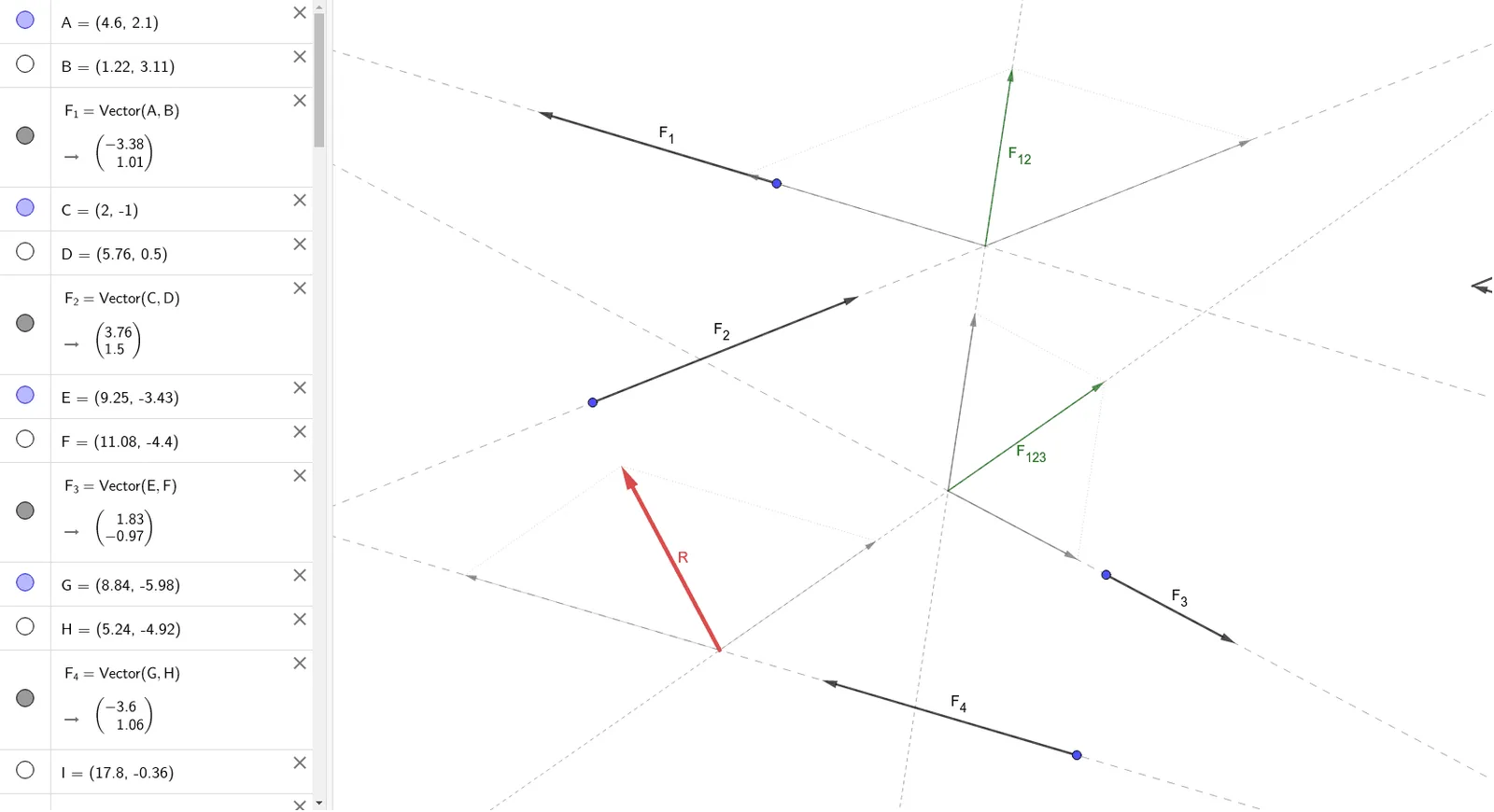
① This GeoGebra example demonstrates the vector composition of four forces, showing how individual force vectors combine into a single resultant force. ② Core mathematical concepts include two-dimensional vector addition, the parallelogram and triangle laws, force decomposition and composition, and geometric construction using vector translation. ③ Construction details: The Vector command creates four force vectors F_1 to F_4; Translate places them head-to-tail; Line and Intersect build auxiliary lines; Segment connects key points; the resultant F_{12} and total resultant are derived. Objects include points A, B, C, etc., vectors u, v, w, and segments a, b, f, etc. ④ Suitable for high school physics or mathematics lessons on vector addition and force composition, as well as introductory university physics, helping students grasp the geometric meaning of vector operations.
GeoGebra Commands & Parameters
Vector(A, B) → F_1Vector(C, D) → F_2Vector(E, F) → F_3Vector(G, H) → F_4Translate(I, F_1) → I'Vector(I, I') → uTranslate(I', F_2) → I''Vector(I', I'') → vTranslate(I'', F_3) → I'''Vector(I'', I''') → wTranslate(I''', F_4) → JVector(I''', J) → aVector(I, J) → bLine(B, A) → fLine(C, D) → gLine(E, F) → hLine(H, G) → iIntersect(f, g) → KTranslate(K, F_1) → K'Vector(K, K') → cTranslate(K, F_2) → K'_1Vector(K, K'_1) → dLine(K', g) → jLine(K'_1, f) → kIntersect(j, k) → LVector(K, L) → F_{12}Segment(K', L) → lSegment(L, K'_1) → mLine(L, K) → nIntersect(h, n) → MTranslate(M, F_3) → M'Vector(M, M') → eTranslate(M, F_{12}) → M'_1Vector(M, M'_1) → pLine(M'_1, h) → qLine(M', n) → rIntersect(q, r) → NVector(M, N) → F_{123}Segment(M'_1, N) → tSegment(N, M') → f_1Line(M, N) → sIntersect(i, s) → OTranslate(O, F_4) → O'Vector(O, O') → u_1Translate(O, F_{123}) → O'_1Vector(O, O'_1) → v_1Line(O', s) → g_1Line(O'_1, i) → h_1Intersect(g_1, h_1) → PVector(O, P) → RSegment(O', P) → i_1Segment(P, O'_1) → j_1