
Region Bounded by Two Quadratics Rotated about x=2
Loading the math board and drawing, please wait…
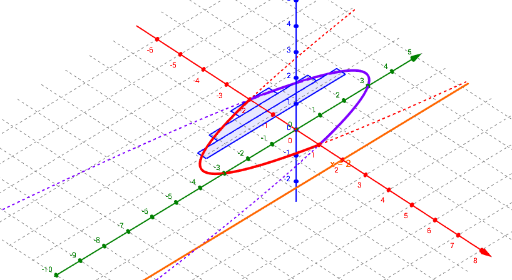
This example demonstrates the region bounded by two quadratic functions rotated about the x=2 axis. Key mathematical concepts include quadratic functions, rotation, integration, and solid geometry. Using GeoGebra commands such as Rotate, Polygon, Vector, and Integral, the region can be constructed. Suitable for high school mathematics education, particularly in coordinate geometry and calculus.
GeoGebra Commands & Parameters
Rotate(f_1, α, a) → f_3Rotate(g_1, α, a) → g_3Polygon((((m - 1) * h) - 2, g(((m - 1 + p) * h) - 2)), ((m * h) - 2, g(((m - 1 + p) * h) - 2)), ((m * h) - 2, f(((m - 1 + p) * h) - 2)), (((m - 1) * h) - 2, f(((m - 1 + p) * h) - 2))) → Rectangle1, i, j, k, lRotate(Rectangle1, α, a) → Rectangle1'Vector((-2 + ((DK + p) * h), g(-2 + ((DK + p) * h))), (-2 + ((DK + p) * h), f(-2 + ((DK + p) * h)))) → UVector((2, g(-2 + ((DK + p) * h))), (-2 + ((DK + p) * h), g(-2 + ((DK + p) * h)))) → VRotate(V, α, a) → R'Rotate(A, α, a) → A'Rotate(B, α, a) → B'Vector(A', B') → H'Integral(((f(x) - g(x)) * (2 - x)), -2, 1) → VolSurface(((2 - u) * (-cos(β))) + 2, g(u), ((2 - u) * sin(β)), u, -2, 1, β, 0, 6.28319) → SurfaceFrontSurface(((2 - u) * (-cos(β))) + 2, f(u), ((2 - u) * sin(β)), u, -2, 1, β, 0, 6.28319) → SurfaceBackIf(togS ≟ 1, "Hide surface", "Show surface") → ShowSurfaceSequence(Polygon[(-2 + (k * h), g(-2 + ((k + p) * h))), (-2 + ((k + 1) * h), g(-2 + ((k + p) * h))), (-2 + ((k + 1) * h), f(-2 + ((k + p) * h))), (-2 + (k * h), f(-2 + ((k + p) * h)))], k, 0, m - 1) → RectanglesRotate(Rectangles, α, a) → Rectangles'If(togSH ≟ 1, "Hide Shells", "Show Shells") → ShowShellIf(togR ≟ 0, "Show one shell", "Show all shells") → ShowOneShellIf(togV ≟ 1, "Hide volume integral", "Show volume integral") → ShowVolumeSequence(Surface[2 - ((4 - (k * h)) * cos(β)), (v * g(-2 + ((k + p) * h))) + ((1 - v) * f(-2 + ((k + p) * h))), ((4 - (k * h)) * sin(β)), v, 0, 1, β, 0, α], k, 0, m - 1) → OutersSequence(Surface[2 - ((4 - ((k + 1) * h)) * cos(β)), (v * g(-2 + ((k + p) * h))) + ((1 - v) * f(-2 + ((k + p) * h))), ((4 - ((k + 1) * h)) * sin(β)), v, 0, 1, β, 0, α], k, 0, m - 1) → InnersSequence(Surface[2 - ((4 - ((k + u) * h)) * cos(β)), g(-2 + ((k + p) * h)), ((4 - ((k + u) * h)) * sin(β)), u, 0, 1, β, 0, α], k, 0, m - 1) → FrontsSequence(Surface[2 - ((4 - ((k + u) * h)) * cos(β)), f(-2 + ((k + p) * h)), ((4 - ((k + u) * h)) * sin(β)), u, 0, 1, β, 0, α], k, 0, m - 1) → BacksRectangleSum((((2 * π) * R(x)) * H(x)), -2, -2 + (m * h), m, p) → VolShellsSurface(((4 - u) * (-cos(β))) + 2, g(((m - 1 + p) * h) - 2), ((4 - u) * sin(β)), u, ((m - 1) * h), (m * h), β, 0, α) → Bottom1Surface(((4 - (m * h)) * (-cos(β))) + 2, v, ((4 - (m * h)) * sin(β)), v, g(((m - 1 + p) * h) - 2), f(((m - 1 + p) * h) - 2), β, 0, α) → InnerSurface1Surface(((4 - ((m - 1) * h)) * (-cos(β))) + 2, v, ((4 - ((m - 1) * h)) * sin(β)), v, g(((m - 1 + p) * h) - 2), f(((m - 1 + p) * h) - 2), β, 0, α) → OuterSurface1Surface(((4 - u) * (-cos(β))) + 2, f(((m - 1 + p) * h) - 2), ((4 - u) * sin(β)), u, ((m - 1) * h), (m * h), β, 0, α) → Top1
AI Drawing Prompt Reference
Create a three‑dimensional solid of revolution formed by rotating the region between two quadratic curves around the vertical line x = 2. Show the outer and inner curved surfaces, as well as the front and back faces, and include top and bottom caps. Illustrate the solid with a series of cylindrical shells that approximate its volume, giving a clear view of the shape’s structure and depth. Use a slightly transparent or shaded appearance to highlight the layered surfaces and the space between the curves.
The prompt above was compiled from the original drawing commands and is for reference only.