
Reflection Matrices: Visualizing Mirror Transformations of Polygons and Parabola
Loading the math board and drawing, please wait…
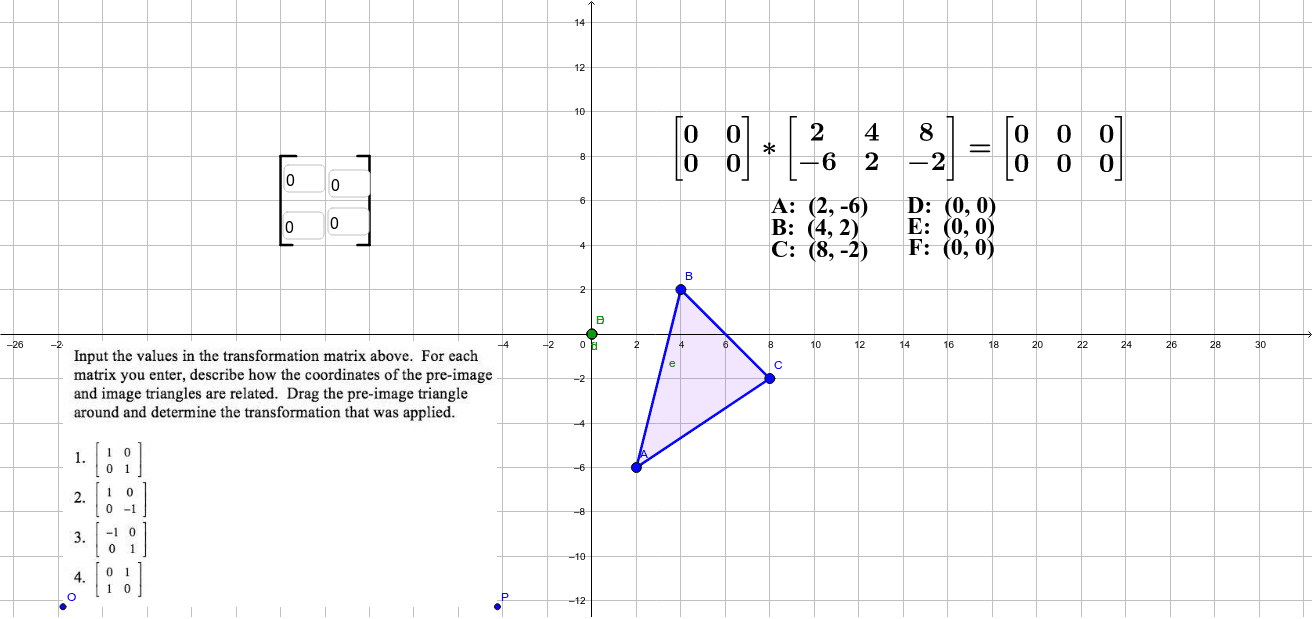
① This GeoGebra example dynamically demonstrates how reflection matrices transform polygons, line segments, and a parabola, providing an intuitive visualization of matrix multiplication as geometric mirroring. ② Core mathematical concepts include matrix multiplication, linear transformations, reflections about coordinate axes or arbitrary lines, and the correspondence between original and transformed figures. ③ Construction highlights: using Polygon to create the original polygon poly1, Line and Point to define the reflection axis, OrthogonalLine and Intersect to compute perpendicular feet and intersection points, and Segment to connect corresponding vertices; Textfield and InputBox allow users to input matrix entries, updating the reflected polygon poly2 and the parabola q in real time; key objects include points A, B, C, D, E, F, G, H, I, and text labels text1 through text6. ④ Suitable for high school or college linear algebra courses to illustrate the geometric meaning of matrix transformations, and for math labs or inquiry-based learning to bridge abstract algebra and visual geometry.
GeoGebra Commands & Parameters
Polygon(A, B, C) → poly1, c, a, bTextfield(m) → InputBox1Textfield(n) → InputBox3Textfield(p) → InputBox4Textfield(o) → InputBox2Polygon(D, E, F) → poly2, f, d, eLine(G, yAxis) → qPoint(q) → HLine(I, q) → rOrthogonalLine(I, r) → sOrthogonalLine(H, q) → tIntersect(r, t) → JSegment(G, H) → a_1Segment(I, J) → b_1Point(t) → KPoint(t) → LPoint(s) → MPoint(s) → NSegment(G, N) → c_1Segment(M, I) → d_1Segment(J, L) → e_1Segment(K, H) → f_1