
Reflection in the Axes: Symmetry of Triangles and Quadrilaterals
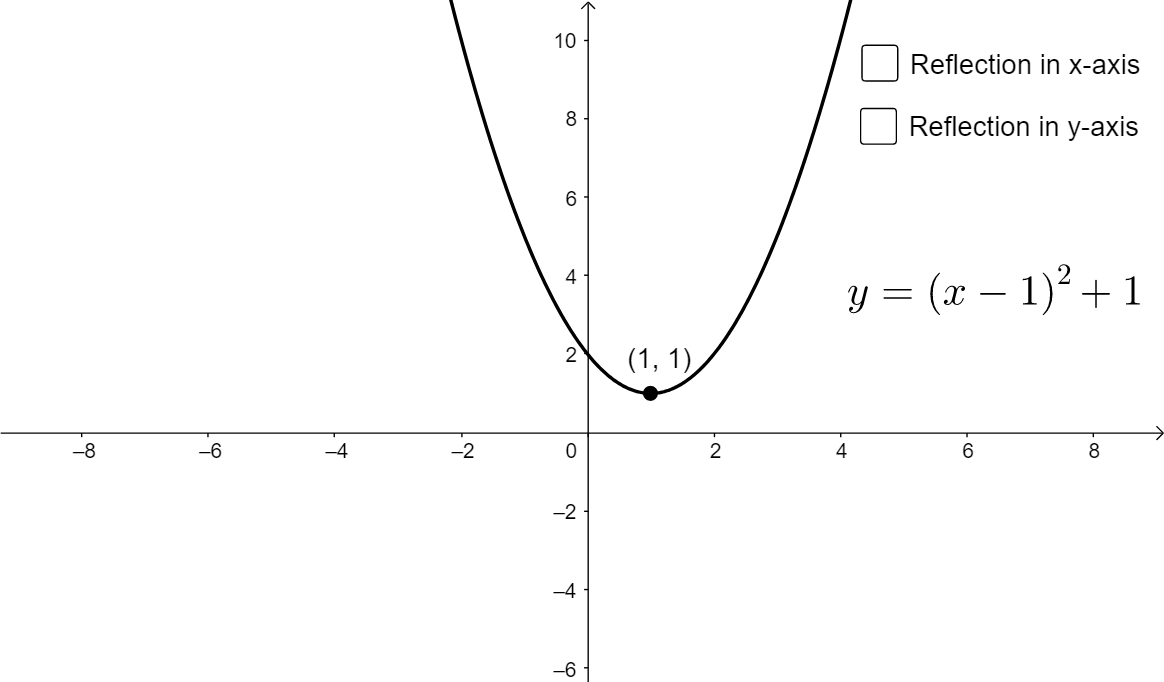
Loading the math board and drawing, please wait…
① This example demonstrates the reflection (axial symmetry) of geometric figures—triangles and quadrilaterals—across the x-axis and y-axis in a Cartesian coordinate plane, showing how positions and shapes change before and after reflection. ② Core mathematical concepts include axial symmetry, reflection transformations, coordinate sign changes (negating x or y coordinates), congruence, and invariance of angles and side lengths. ③ Construction highlights: Based on the construction summary, it uses GeoGebra's Point command to create key points A, B, C, along with objects f, g, h (likely lines or functions) and text labels text1, text2, text3 for coordinates and annotations; reflected figures are generated to observe congruence between the original and transformed shapes. ④ Suitable for middle school geometry transformation lessons or self-study, helping students grasp coordinate rules of reflection, and also useful for high school analytic geometry demonstrations of symmetry.
GeoGebra Commands & Parameters
Point(f) → A
AI Drawing Prompt Reference
In a Cartesian coordinate plane, draw a triangle and a quadrilateral, then reflect both across the x-axis and y-axis to show axial symmetry. First plot the original shapes with labeled vertices and their coordinates. Then construct the reflected images, ensuring they are congruent to the originals with equal side lengths and angles. Use dashed lines or different colors to distinguish original from reflected figures, and mark the axes of reflection. Also display the coordinate changes of corresponding vertices, such as sign flips in x or y values, to illustrate the coordinate rules of reflection.
The prompt above was compiled from the original drawing commands and is for reference only.