
Reflection Composition: Geometric Transformations and Function Graphs
Loading the math board and drawing, please wait…
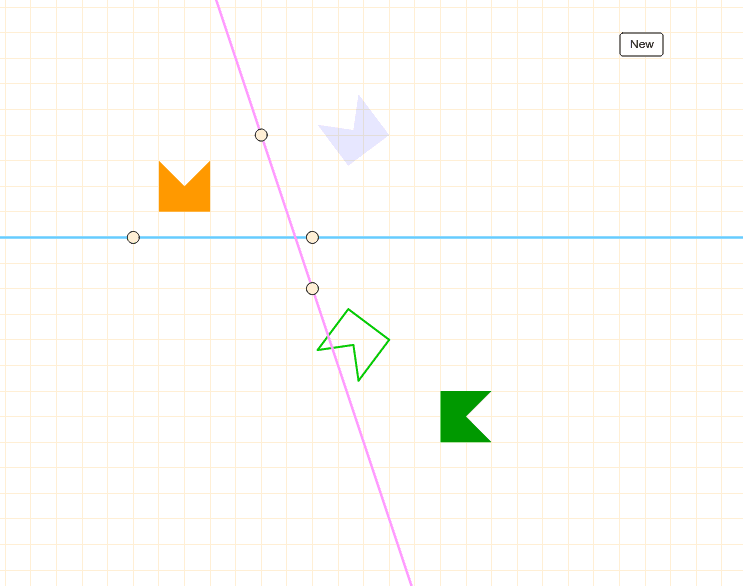
This example demonstrates the construction of geometric figures through reflection transformations and analyzes the relationship between function graphs. Key mathematical concepts include reflection, set theory, indefinite integral, orthocenter, function graph, and subtraction. Construction involves GeoGebra commands such as Line, Intersect, Element, Mirror, If, Polygon, Point, Translate, Vector, PolyLine, Angle, and objects like A_4, A_3, t, A_2, A_1, m, corte, puntos, centros, vectores, ángulos, n, P, punto, v, mov, α, O, cond2, P≈, cond1, A_5, B, C, D, fig1, a, b, c, d, E, F, G, H, I, fig2, e, f, g, h. Suitable for high school students or college undergraduates learning geometric transformations and function graph analysis.
GeoGebra Commands & Parameters
Line(A_3, A_4) → tLine(A_1, A_2) → mIntersect(m, t) → corteElement(puntos, n) → PMirror(Mirror[P, m], t) → puntoElement(vectores, n) → vIf(n > 16, "R", "T") → movElement(ángulos, n - 16) → αElement(centros, n - 16) → OIf(mov ≟ "T", Translate[P, v], Rotate[P, α, O]) → P'Polygon(A_5, B, C, D) → fig1, a, b, c, dPoint(yAxis) → HPoint(yAxis) → IPolygon(E, F, G, H, I) → fig2, e, f, g, h, iPoint(xAxis) → JPolygon(J, K, L, M, N, O_1) → fig3, j, k, l, m_1, n_1, oPolygon(P_1, Q, R, S, T) → fig4, p, q, r, s, fig4_1Element(figuras, If[n < 17, Div[n - 1, 4] + 1, Div[n - 17, 4] + 1]) → figTranslate(A_5, v) → A'Translate(B, v) → B'Translate(C, v) → C'If(mov ≟ "T", Translate[fig, v], Rotate[fig, α, O]) → imagenTranslate(D, v) → D'Vector(P, P') → uPolyLine(P, O, P') → ladosIf(mov ≟ "R", cond1 ∧ cond2, cond1) → prontoAngle(P, O, P') → βMirror(fig, m) → fig'Mirror(fig', t) → fig''
AI Drawing Prompt Reference
Draw a geometric figure constructed through reflection transformations. Include a line, a intersecting line, a intersection point, a vector, a rotation center, and an angle. The construction order is to first draw the lines and intersection point, then reflect to get new points, apply vector translation and rotation, and finally draw a polygon and another polygon. The figure should illustrate the relationships between reflection, rotation, and translation.
The prompt above was compiled from the original drawing commands and is for reference only.