
Reference Angle in the Third Quadrant
Loading the math board and drawing, please wait…
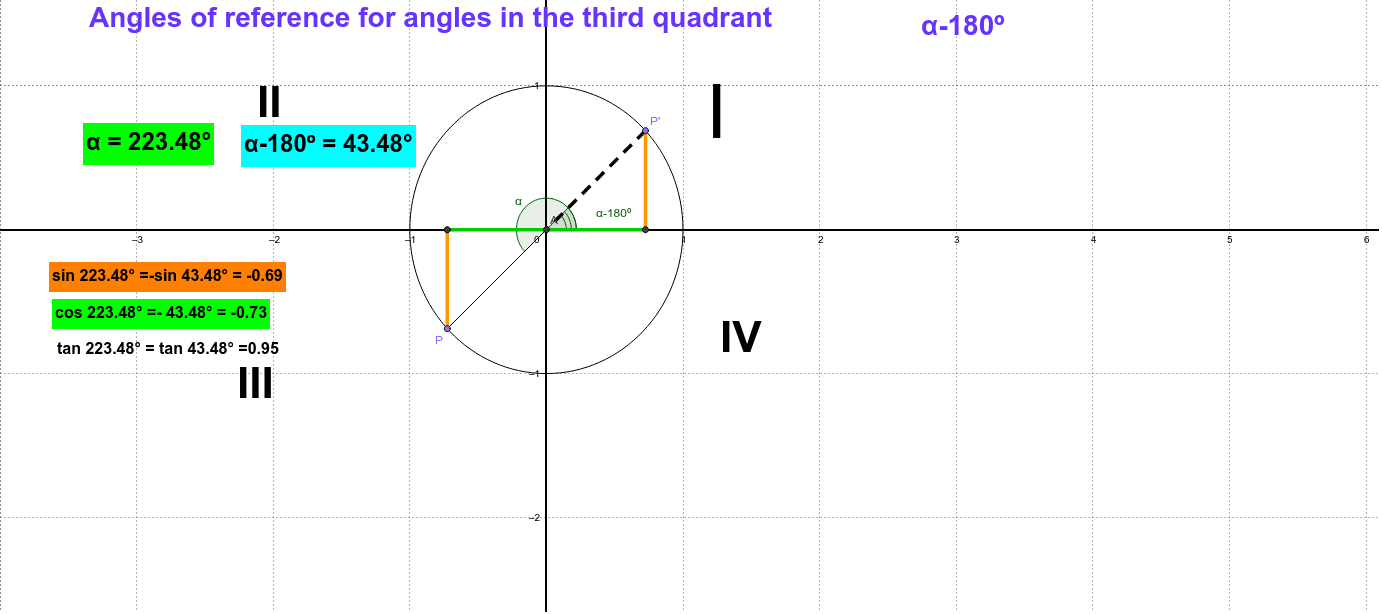
This GeoGebra example visually demonstrates the relationship between the trigonometric ratios of an arbitrary angle A and those of its reference angle A − π in the third quadrant. Through dynamic point reflection, circle intersections, and rotation transformations, it illustrates how sine, cosine, and tangent change in sign and magnitude across the third quadrant. The construction employs core GeoGebra commands such as Intersect, Circle, Rotate, and Mirror, along with points, segments, angles, and quadrant markers to build a chain of geometric transformations. It is suitable for high school trigonometry units, pre-calculus courses, or independent exploratory learning, helping students grasp the definition of reference angles and quadrant-specific trigonometric behavior from a dynamic geometry perspective.
GeoGebra Commands & Parameters
Intersect(xAxis, yAxis) → ACircle(A, 1) → cPoint(c) → PSegment(P, A) → aIntersect(c, xAxis, 1) → CAngle(C, A, P) → αMirror(A, yAxis) → A'OrthogonalLine(P, xAxis) → bIntersect(b, xAxis) → DSegment(D, P) → eSegment(D, A') → gMirror(A', P) → A''Rotate(P, 180*°, A') → P'Rotate(A, 180*°, A') → A'_1Segment(P', A'_1) → a'Rotate(D, 180*°, A') → D'Rotate(A', 180*°, A') → A''_1Segment(D', A''_1) → g'Segment(P', D') → dAngle(D', A, P') → β