
Rectangular Cake Problem: Geometric Construction for Equal Area Division
Loading the math board and drawing, please wait…
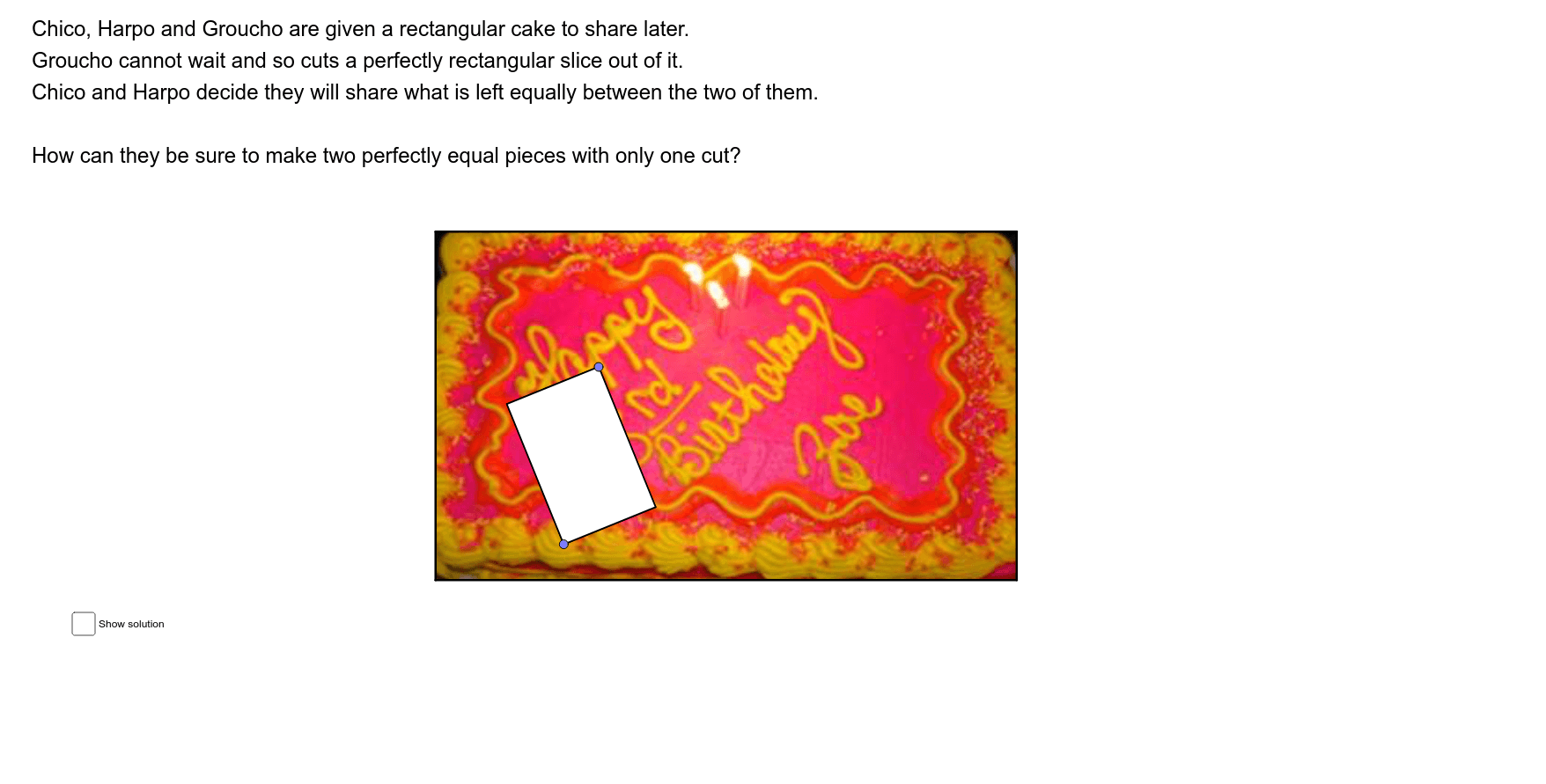
This example demonstrates the classic rectangular cake cutting problem where a single straight cut divides the cake into two equal-area pieces. Key mathematical concepts include rectangle properties, angle bisectors, symmetry, and area calculation. The construction uses GeoGebra commands: Intersect (finding intersection points), Point (creating points), Segment (constructing line segments), OrthogonalLine (drawing perpendicular lines), Polygon (creating polygons), Line (drawing lines), and PointIn (creating points inside regions). Ideal for middle school students learning geometric construction, or as an interactive demonstration for teaching area and symmetry concepts. Also suitable for exploring optimization principles in cutting problems.
GeoGebra Commands & Parameters
Intersect(xAxis, yAxis) → APoint(xAxis) → BPoint(yAxis) → CSegment(F, E) → aOrthogonalLine(F, a) → bOrthogonalLine(E, a) → cPoint(c) → GOrthogonalLine(G, b) → dIntersect(b, d) → HPolygon(F, E, G, H) → poly1, f, e, g, hPolygon(C, A, B, D) → poly2, c_1, a_1, b_1, d_1Segment(F, G) → iSegment(H, E) → jSegment(C, B) → kSegment(D, A) → lIntersect(k, l) → IIntersect(i, j) → JLine(J, I) → mSegment(F, E) → nSegment(E, G) → pSegment(G, H) → qSegment(F, H) → rIntersect(m, r) → KIntersect(m, p) → LIntersect(c_1, m) → MIntersect(m, b_1) → NPolygon(L, M, A, B, N, K, H, G) → poly3, l_1, m_1, a_2, b_2, n_1, k_1, h_1, g_1Intersect(n, p) → OIntersect(n, r) → PPolygon(M, L, O, P, K, N, D, C) → poly4, m_2, l_2, o, p_1, k_2, n_2, d_2, c_2Segment(P, G) → sSegment(O, H) → tSegment(Q, B) → e_1Segment(R, S) → f_1PointIn(poly4) → Pointpoly4PointIn(poly3) → Pointpoly3
AI Drawing Prompt Reference
Draw a rectangular cake and divide it into two equal-area parts with a single straight cut. Start by taking points A and B on the x-axis and y-axis respectively. Then draw perpendicular lines b and c through points F and E, and let G and H be the intersection points of these lines. Next, draw rectangles FEGH and CABD. Then construct polygons using points F, G, H, E, C, B, D, and A to ensure each part has equal area. Finally, construct polygons using these points to ensure each part has equal area.
The prompt above was compiled from the original drawing commands and is for reference only.