
Rectangle Area
Loading the math board and drawing, please wait…
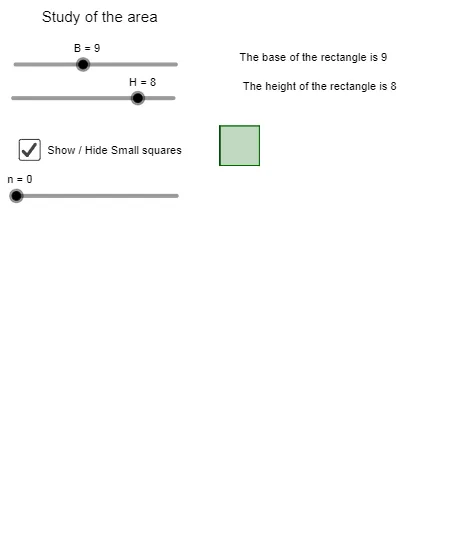
This example demonstrates how to calculate the area of a rectangle using geometric construction. Key mathematical concepts include the properties of rectangles and area calculation. It uses commands like Polygon, Segment, and Join in GeoGebra. Suitable for middle school and above students learning geometry and area calculation.
GeoGebra Commands & Parameters
Circle(H_1, lado_1) → fPolygon(A_1, B_1, C, D) → pol1, a, b, c, dPoint(f) → K_1Point(f) → IMidpoint(c) → L_1Midpoint(b) → M_1Join(Sequence[Sequence[(i, j), i, 0, B - 1], j, 0, H - 1]) → L1Segment(K_1, H_1) → gPolygon(H_1, K_1, 4) → pol2, i, j, k, l, E, GCircle(J, lado_2) → hPoint(h) → N_1Polygon(J, N_1, 4) → pol3, m, p, q, r, O, PJoin(Sequence[Sequence[((r * 0.5), (m * 0.5)), r, 0, (2 * B) - 1], m, 0, (2 * H)]) → MSequence(Polygon[Element[L1, i], (x(Element[L1, i] + 1), y(Element[L1, i])), 4], i, 1, n) → KSequence(Polygon[Element[M, m], (x(Element[M, m] + 0.5), y(Element[M, m])), 4], m, 1, (4 * e)) → NPolygon(A, B_1, C, D) → q1, a_1, b_1, c_1, d_1
AI Drawing Prompt Reference
Draw a rectangle to demonstrate the calculation of its area through geometric construction. First, create a rectangle and find the midpoints of its sides, then connect these midpoints to form a new shape. Next, draw two equal circles inside the rectangle and locate their intersections with the rectangle. Finally, connect these intersection points to form a complex pattern, illustrating the area calculation process of the rectangle.
The prompt above was compiled from the original drawing commands and is for reference only.