
Ratio of Perimeter, Area & Volume
Loading the math board and drawing, please wait…
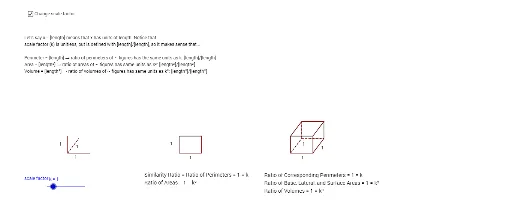
This example demonstrates the ratio between perimeter, area, and volume. Key mathematical concepts include geometry, perimeter, area, and volume, as well as complex numbers. Using GeoGebra commands such as Intersect, Point, and Vector, it dynamically illustrates these concepts. Suitable for high school and above students or teachers.
GeoGebra Commands & Parameters
Intersect(xAxis, yAxis) → APoint(yAxis) → CPoint(xAxis) → BPoint(xAxis) → EPoint(xAxis) → FVector(A, A) → v_0Sequence(E + Element[vectors, Element[combo_2, k]] + Element[vectors, Element[combo_2, k + 1]], k, 1, Length[combo_2], 2) → points_2Sequence(F + Element[vectors, Element[combo_3, k]] + Element[vectors, Element[combo_3, k + 1]], k, 1, Length[combo_3], 2) → points_3Point(points_2) → HSegment(E, H) → d_1Point(points_2) → ISegment(H, I) → ePoint(points_2) → JSegment(I, J) → fSegment(J, E) → gPoint(points_3) → KSegment(F, K) → h_1Point(points_3) → LSegment(K, L) → iPoint(points_3) → MSegment(L, M) → jSegment(M, F) → k_1Point(points_3) → NPoint(points_3) → OSegment(N, O) → lPoint(points_3) → PSegment(O, P) → mSegment(P, G) → nSegment(G, N) → pSegment(M, N) → qSegment(L, G) → rSegment(F, O) → sSegment(K, P) → tSequence(A + Element[vectors, k], k, 2, 4, 1) → points_1Point(points_1) → QSegment(A, Q) → aPoint(points_1) → RSegment(A, R) → bPoint(points_1) → SSegment(A, S) → cSegment(A, B) → a_0Segment(A, C) → b_0Segment(A, D) → c_0Segment(E, E + (1, 0)) → d_0Segment(E + (1, 0), E + (1, 0) + (0, 1)) → e_0Segment(E + (1, 0) + (0, 1), E + (0, 1)) → f_0Segment(E, E + (0, 1)) → g_0Segment(F, F + (1, 0)) → h_0Segment(F + (1, 0), F + (1, 0) + (0, 1)) → i_0Segment(F + (1, 0) + (0, 1), F + (0, 1)) → j_0Segment(F, F + (0, 1)) → k_0Segment(F + (cos(π / 3), sin(π / 3)), F + (cos(π / 3), sin(π / 3)) + (0, 1)) → l_0Segment(F + (cos(π / 3), sin(π / 3)), F + (cos(π / 3), sin(π / 3)) + (1, 0)) → m_0Segment(F + (cos(π / 3), sin(π / 3)) + (1, 0), F + (cos(π / 3), sin(π / 3)) + (1, 0) + (0, 1)) → n_0Segment(F + (cos(π / 3), sin(π / 3)) + (1, 0) + (0, 1), F + (cos(π / 3), sin(π / 3)) + (0, 1)) → p_0Segment(F + (0, 1), F + (cos(π / 3), sin(π / 3)) + (0, 1)) → q_0Segment(F + (1, 0) + (0, 1), F + (1, 0) + (0, 1) + (cos(π / 3), sin(π / 3))) → r_0Segment(F, F + (cos(π / 3), sin(π / 3))) → s_0Segment(F + (1, 0), F + (1, 0) + (cos(π / 3), sin(π / 3))) → t_0