
Randomly Generating Sierpinski's Triangle
Loading the math board and drawing, please wait…
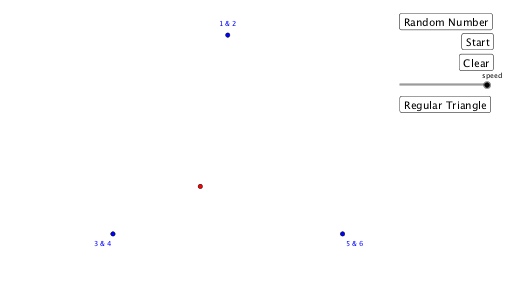
This example demonstrates how to randomly generate Sierpinski's Triangle, a self-similar fractal. Sierpinski's Triangle involves the iterative process in geometry. Using the Polygon command in GeoGebra, users can observe the self-similarity through the iterative generation of the triangle. Suitable for high school and above students to learn about fractal geometry and iterative processes.
GeoGebra Commands & Parameters
Polygon(E, F, 3) → G, f, g, h, H
AI Drawing Prompt Reference
Draw a self-similar Sierpinski Triangle to demonstrate its geometric construction and probabilistic relationships through an iterative process. Start by drawing a triangle, then randomly select one of its vertices and connect it to the midpoint of the opposite side to form a smaller triangle. Repeat this process iteratively, continuously generating smaller triangles, to create a complex fractal pattern that exhibits self-similarity through iterative generation.
The prompt above was compiled from the original drawing commands and is for reference only.