
Random Operation on Two Sets
Loading the math board and drawing, please wait…
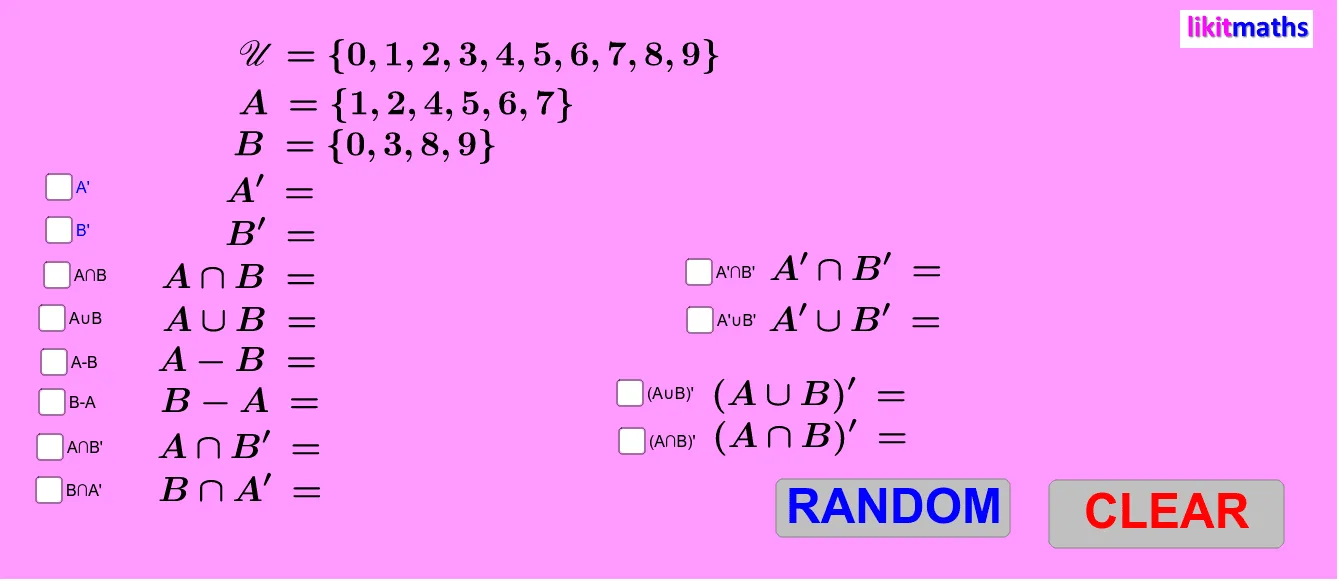
This example demonstrates how to perform random operations on two sets. Key mathematical concepts include set theory and randomness. Using GeoGebra commands such as Sort, Random, Min, Max, etc., a dynamic graphical representation of random set operations is constructed. Suitable for high school mathematics education and learning set theory concepts.
GeoGebra Commands & Parameters
Sort(list1) → sort1Sort(list2) → sort2Random(1, 10) → aRandom(1, 10) → bMin(a, b) → min1Max(a, b) → max1Element(sort1, A1) → C1Element(sort1, A2) → C2Element(sort1, A3) → C3Element(sort1, A4) → C4Element(sort1, A5) → C5Element(sort1, A6) → C6Element(sort1, A7) → C7Element(sort1, A8) → C8Element(sort1, A9) → C9Element(sort1, A10) → C10Element(sort2, A1) → F1Element(sort2, A2) → F2Element(sort2, A3) → F3Element(sort2, A4) → F4Element(sort2, A5) → F5Element(sort2, A6) → F6Element(sort2, A7) → F7Element(sort2, A8) → F8Element(sort2, A9) → F9Element(sort2, A10) → F10Random(1, 10) → cRandom(1, 10) → dMin(c, d) → min2Sort(U_A) → UMax(c, d) → max2Sort(Take[U_A, min1, max1]) → ASort(Take[U_B, min2, max2]) → BSort(Union[A, B]) → AuBIntersection(A, B) → AnBIntersection(A, B') → AnB'Intersection(B, A') → BnA'Sort(Union[A', B']) → A'uB'Intersection(A', B') → A'nB'
AI Drawing Prompt Reference
Draw the graphical representation of two sets of random integers, including sorted sets, random element selection, minimum and maximum values, union, intersection, and complement. First, sort two sets of random integers, then randomly select elements, calculate minimum and maximum values, and finally compute the union, intersection, and complements of the sets.
The prompt above was compiled from the original drawing commands and is for reference only.