
Ramsey Graphs and Random Experiments
Loading the math board and drawing, please wait…
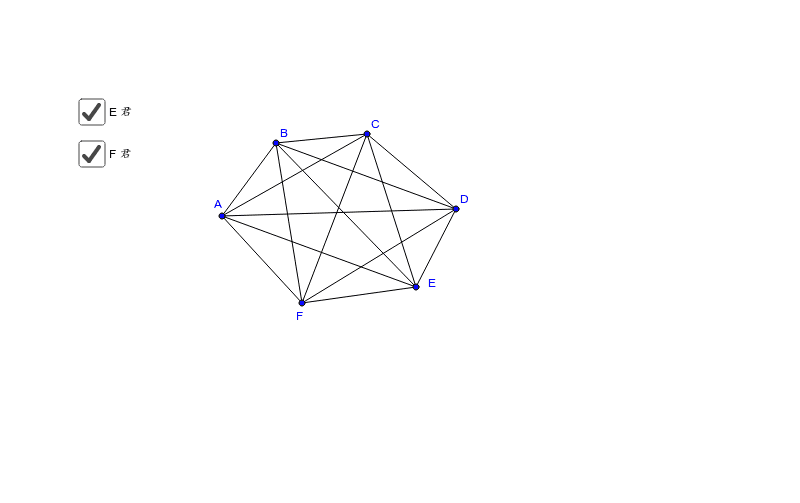
This example demonstrates the phenomena of Ramsey theory in graphs and random experiments. Core mathematical concepts include function graphs, random experiments, terms, secant lines, set theory, and correlation. Construction highlights involve using the Segment command and objects like A, B, C, D, E, F, a, b, c, d, e, f, g, h, i, j, k, l, m, n, p, pp, aa, bb, cc, dd, ee, ff, gg, hh, ii, jj, kk, ll, mm, nn, o, q. Suitable for high school and above learners to understand basic concepts in combinatorial mathematics and probability & statistics.
GeoGebra Commands & Parameters
Segment(B, A) → aSegment(A, F) → bSegment(A, E) → cSegment(A, D) → dSegment(F, B) → eSegment(F, C) → fSegment(F, D) → gSegment(F, E) → hSegment(A, C) → iSegment(E, C) → jSegment(E, D) → kSegment(B, D) → lSegment(C, D) → mSegment(C, B) → nSegment(B, E) → p
AI Drawing Prompt Reference
Draw a figure with multiple points A, B, C, D, E, and F, and connect them with several line segments, including AB, AF, AE, AD, FB, FC, FD, FE, AC, EC, ED, BD, CD, BC, and BE. These segments illustrate concepts from Ramsey theory in graph theory, aiding in understanding basic ideas in combinatorial mathematics and probability & statistics.
The prompt above was compiled from the original drawing commands and is for reference only.