
Radical Numbers Construction by Ramesses R.
Loading the math board and drawing, please wait…
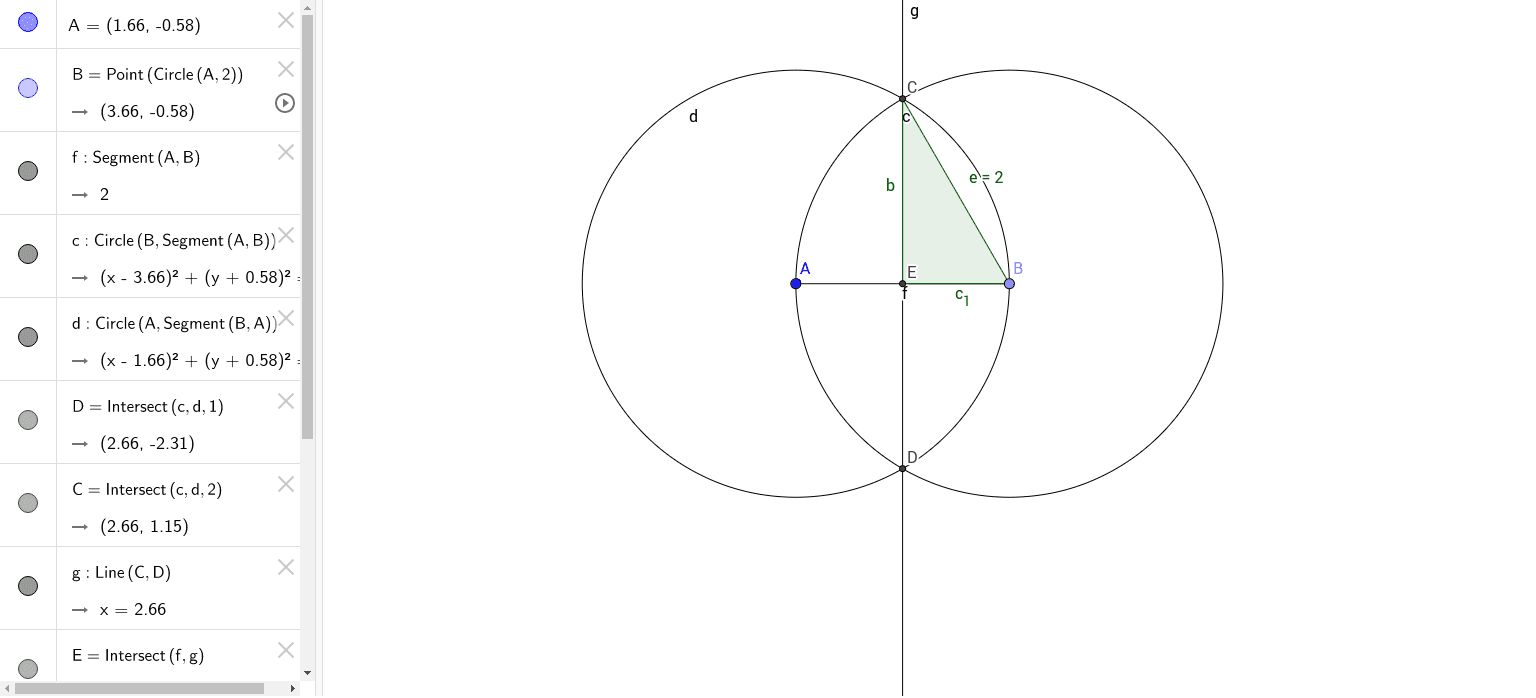
①This example demonstrates how to geometrically construct radical numbers (like √2, √3) on a number line using straightedge-and-compass methods, visually proving the existence of irrational lengths. ②Core mathematical concepts include irrational numbers, the Pythagorean theorem, geometric construction, points and segments on a number line, and the recursive construction of square-root lengths. ③Construction details: Based on the summary, the GeoGebra commands used are Point, Segment, Circle, Intersect, Line, and Polygon, with objects A, B, f, c, d, D, C, g, E, poly1, b, c_1, and e. The process typically involves drawing perpendicular segments, using circles to transfer lengths, and intersecting lines to obtain successive radical lengths. ④This is suitable for upper middle school or high school students, ideal for classroom demonstrations on irrational numbers, geometric construction, or connecting algebra with geometry.
GeoGebra Commands & Parameters
Point(Circle[A, 2]) → BSegment(A, B) → fCircle(B, Segment[A, B]) → cCircle(A, Segment[B, A]) → dIntersect(c, d, 1) → DIntersect(c, d, 2) → CLine(C, D) → gIntersect(f, g) → EPolygon(C, E, B) → poly1, b, c_1, e
AI Drawing Prompt Reference
Construct a geometric representation of irrational numbers like √2 on a number line using straightedge and compass. Start by placing a point, draw a segment, create two circles with the segment as diameter and radius respectively, and find their intersection points to locate the irrational number, visually demonstrating its existence.
The prompt above was compiled from the original drawing commands and is for reference only.