
Quadrilaterals Formed by Two Isosceles Triangles
Loading the math board and drawing, please wait…
In collections
Quadrilaterals
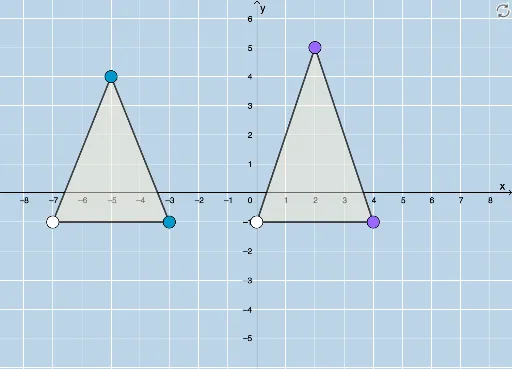
By placing any two isosceles triangles adjacent to each other, what kinds of quadrilaterals can you form? This example demonstrates the different ways isosceles triangles can be joined and the types of quadrilaterals they form. Key mathematical concepts include the properties of isosceles triangles and the classification of quadrilaterals. The construction uses GeoGebra commands such as Circle, Point, Segment, and Polygon. Suitable for middle school and above students learning geometric construction and quadrilateral classification.
GeoGebra Commands & Parameters
Circle(A, B) → cPoint(c) → CCircle(D, E) → dPoint(d) → FSegment(A, C) → fSegment(A, B) → gSegment(C, B) → hSegment(F, D) → iSegment(D, E) → jSegment(E, F) → kPolygon(A, C, B) → t1, b, a, c_1Polygon(D, F, E) → t2, e, d_1, f_1