
Quadrilateral Identification: Geometric Construction and Classification
Loading the math board and drawing, please wait…
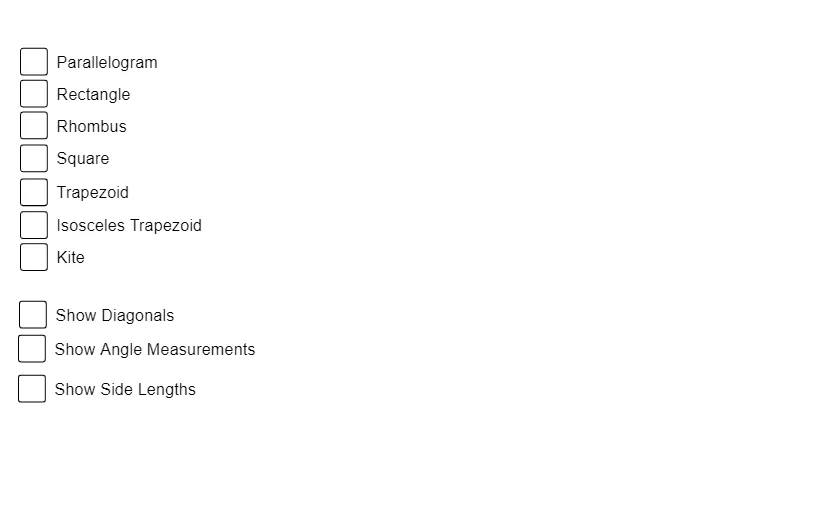
This GeoGebra example demonstrates how to dynamically construct and identify different types of quadrilaterals, including general quadrilaterals, parallelograms, rectangles, and rhombi, while exploring their side and angle relationships. The core mathematical concepts involve definitions and properties of quadrilaterals, angle measurement, segment ratios, similar triangles, and linear equations. The construction uses GeoGebra commands such as Segment, Line, Intersect, Angle, OrthogonalLine, Point, Rotate, and Circle, creating multiple auxiliary objects like points A, B, C, D, segments a, b, c, and angles α, β, γ, δ. By adjusting these elements, learners can observe how quadrilateral properties change. This resource is suitable for middle and high school geometry classes, helping students intuitively understand quadrilateral classification and criteria, and is also valuable for inquiry-based learning or teacher demonstrations.
GeoGebra Commands & Parameters
Segment(A, B) → fLine(C, f) → gSegment(A, C) → hLine(B, h) → iIntersect(g, i) → DSegment(C, D) → jSegment(D, B) → kAngle(C, A, B) → αAngle(B, D, C) → βAngle(D, C, A) → γAngle(A, B, D) → δSegment(C, A) → lSegment(A, B) → mSegment(C, D) → nSegment(D, B) → pSegment(E, F) → qOrthogonalLine(E, q) → rOrthogonalLine(F, q) → sPoint(r) → GOrthogonalLine(G, r) → tIntersect(t, s) → HAngle(G, E, F) → εAngle(E, F, H) → ζAngle(H, G, E) → ηAngle(F, H, G) → θSegment(E, G) → dSegment(G, H) → eSegment(H, F) → f_1Segment(E, G) → g_1Segment(G, H) → h_1Segment(H, F) → i_1Segment(F, E) → j_1Segment(E, F) → k_1Point(Circle[I, n_1]) → JSegment(I, J) → l_1Point(Circle[I, n_1]) → KSegment(I, K) → m_1Line(J, m_1) → p_1Line(K, l_1) → q_1Intersect(q_1, p_1) → LSegment(K, L) → r_1Segment(L, J) → s_1Segment(I, K) → t_1Segment(K, L) → e_1Segment(L, J) → f_2Segment(J, I) → g_2Angle(K, I, J) → ιAngle(J, L, K) → κAngle(L, K, I) → λAngle(I, J, L) → μSegment(Q, R) → a_2Line(S, a_2) → b_2Segment(Q, S) → c_2Point(b_2) → TSegment(R, T) → d_2Angle(S, Q, R) → σAngle(R, T, S) → τAngle(T, S, Q) → υAngle(Q, R, T) → ϕSegment(S, T) → e_2Segment(Q, S) → f_3Segment(S, T) → g_3Segment(T, R) → h_3Segment(Q, R) → j_3Segment(U, V) → i_3Point(Circle[U, n_3]) → WRotate(U, x_1, V) → U'Angle(U, V, U') → χLine(V, U') → l_3Line(W, i_3) → m_3Intersect(m_3, l_3) → ZRotate(V, (-x_1), U) → V'Angle(V', U, V) → ψLine(U, V') → k_3Intersect(k_3, m_3) → A_1Segment(U, A_1) → p_3Segment(A_1, Z) → q_3Angle(Z, A_1, U) → ωAngle(V, Z, A_1) → α_1Segment(A_1, U) → s_3Segment(U, V) → t_3Segment(Z, A_1) → a_3Segment(V, Z) → c_3Line(B_1, C_1) → b_3OrthogonalLine(D_1, b_3) → d_3Intersect(b_3, d_3) → E_1Circle(E_1, D_1) → e_3Intersect(e_3, d_3) → F_1, G_1Segment(B_1, D_1) → f_4Segment(D_1, C_1) → g_4Segment(C_1, G_1) → h_4Segment(G_1, B_1) → i_4Segment(D_1, B_1) → j_4Segment(B_1, G_1) → k_4Segment(G_1, C_1) → l_4Segment(C_1, D_1) → m_4Segment(D_1, G_1) → n_4Segment(B_1, C_1) → p_4Angle(B_1, G_1, D_1) → β_1Angle(C_1, D_1, G_1) → γ_1Angle(D_1, G_1, C_1) → δ_1Angle(G_1, C_1, B_1) → ε_1Angle(B_1, C_1, D_1) → ζ_1Angle(G_1, D_1, B_1) → η_1Angle(D_1, B_1, C_1) → θ_1Angle(C_1, B_1, G_1) → ι_1Intersect(n_4, p_4) → H_1Angle(B_1, H_1, D_1) → κ_1Segment(B_1, H_1) → q_4Segment(G_1, H_1) → r_4Segment(H_1, D_1) → s_4Segment(H_1, C_1) → t_4Segment(U, A_1) → a_4Segment(A_1, Z) → b_4Segment(Z, V) → c_4Segment(V, U) → d_4Segment(U, Z) → e_4Segment(V, A_1) → f_5Intersect(e_4, f_5) → I_1Segment(U, I_1) → g_5Segment(I_1, V) → h_5Segment(I_1, Z) → i_5Segment(I_1, A_1) → j_5Segment(A, D) → k_5Segment(C, B) → l_5Intersect(l_5, k_5) → J_1Segment(A, J_1) → m_5Segment(J_1, D) → n_5Segment(C, J_1) → p_5Segment(J_1, B) → q_5Segment(E, H) → r_5Segment(F, G) → s_5Intersect(r_5, s_5) → K_1Segment(E, K_1) → t_5Segment(K_1, H) → a_5Segment(F, K_1) → b_5Segment(K_1, G) → c_5Segment(K, J) → d_5Segment(I, L) → e_5Intersect(d_5, e_5) → L_1Segment(K, L_1) → f_6Segment(L_1, J) → g_6Segment(I, L_1) → h_6Segment(L_1, L) → i_6Segment(R, S) → l_6Segment(Q, T) → m_6Intersect(m_6, l_6) → M_1Segment(Q, M_1) → n_6Segment(M_1, T) → p_6Segment(R, M_1) → q_6Segment(M_1, S) → r_6Angle(B_1, G_1, C_1) → λ_1Angle(D_1, B_1, G_1) → μ_1Angle(G_1, C_1, D_1) → ν_1Angle(C_1, D_1, B_1) → ξ_1Segment(K, I) → c_6Angle(S, Q, M_1) → ο_1Angle(M_1, Q, R) → ρ_1Angle(M_1, R, T) → σ_1Angle(Q, R, M_1) → τ_1Angle(R, T, M_1) → υ_1Angle(M_1, T, S) → ϕ_1Angle(S, M_1, T) → χ_1Angle(T, S, M_1) → ψ_1Angle(M_1, S, Q) → ω_1Angle(T, M_1, R) → α_2Angle(D, C, J_1) → β_2Angle(J_1, C, A) → γ_2Angle(A, B, J_1) → δ_2Angle(J_1, B, D) → ε_2Angle(B, D, J_1) → ζ_2Angle(J_1, D, C) → η_2Angle(C, J_1, D) → θ_2Angle(D, J_1, B) → ι_2Angle(C, A, J_1) → κ_2Angle(J_1, A, B) → λ_2Angle(F, H, K_1) → μ_2Angle(K_1, H, G) → ν_2Angle(G, E, K_1) → ξ_2Angle(K_1, E, F) → ο_2Angle(E, F, K_1) → ρ_2Angle(K_1, G, E) → σ_2Angle(K_1, F, H) → τ_2Angle(H, G, K_1) → υ_2Angle(F, K_1, E) → ϕ_2Angle(E, K_1, G) → χ_2Angle(J, L, L_1) → ψ_2Angle(L_1, L, K) → ω_2Angle(K, I, L_1) → α_3Angle(L_1, I, J) → β_3Angle(I, J, L_1) → γ_3Angle(L_1, J, L) → δ_3Angle(L, K, L_1) → ε_3Angle(L_1, K, I) → ζ_3Angle(I, L_1, K) → η_3Angle(U, V, I_1) → τ_3Angle(I_1, U, V) → υ_3Angle(V, Z, I_1) → ϕ_3Angle(I_1, Z, A_1) → χ_3Angle(Z, A_1, I_1) → ψ_3Angle(I_1, A_1, U) → ω_3Angle(U, I_1, A_1) → α_4Angle(A_1, U, I_1) → β_4Angle(I_1, V, Z) → γ_4Angle(A_1, I_1, Z) → δ_4Point(Circle[M, n_2]) → NSegment(M, N) → h_2Rotate(N, (-(90°)), M) → N'Angle(N', M, N) → νRotate(M, 90°, N) → M'Angle(M, N, M') → ξSegment(M, N') → i_2Segment(N', M') → j_2Segment(M', N) → k_2Angle(M', N', M) → οAngle(N, M', N') → ρSegment(M, N') → l_2Segment(M, N) → m_2Segment(N, M') → p_2Segment(M', N') → q_2Segment(N', N) → r_2Segment(M, M') → s_2Intersect(s_2, r_2) → OSegment(O, M) → t_2Segment(O, N) → r_3Segment(O, M') → j_6Segment(O, N') → k_6Angle(N', M, O) → θ_3Angle(O, M, N) → ι_3Angle(O, N, M') → κ_3Angle(M', N', O) → λ_3Angle(N, M', O) → μ_3Angle(O, N', M) → ν_3Angle(M, N, O) → ξ_3Angle(N', O, M') → ο_3Angle(O, M', N') → ρ_3
AI Drawing Prompt Reference
Draw a quadrilateral ABCD, connect points A and B, C and A, B and D, C and D, and find the intersection point D. Then draw angles α, β, γ, δ, and line segments l, m, n, p, construct points G and H, draw angles ε, ζ, η, θ, and finally draw line segments d, e, f_1, g_1, h_1, i_1, j_1, k_1.
The prompt above was compiled from the original drawing commands and is for reference only.