
Quadrilateral Exterior Angle Sum Activity
Loading the math board and drawing, please wait…
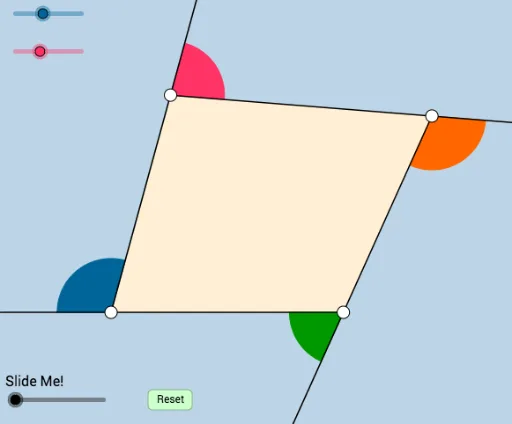
This example demonstrates the sum of exterior angles in a quadrilateral through an interactive and modifiable activity. Key math concepts include exterior angles, interior angles, and the polygon interior angle sum theorem. GeoGebra commands/objects used in construction are Rotate, Angle, Ray, Segment, Point, Min, Circle, Intersect, CircleSector, Line, Dilate, Vector, Translate, and Polygon. Suitable for middle school and above students to explore and understand the properties of exterior angle sums in polygons, as well as for geometric construction teaching.
GeoGebra Commands & Parameters
Rotate(A, (a * π / 180), B) → A'Angle(A, B, A') → αRay(B, A') → fSegment(B, A) → gPoint(f) → CAngle(B, C, A) → βRotate(B, γ, C) → B'Angle(B, C, B') → δRay(C, B') → hPoint(h) → DRay(D, A) → iSegment(A, B) → jSegment(B, C) → kSegment(C, D) → lSegment(D, A) → mMin({j, k, l, m}) → bRay(A, B) → nRay(B, C) → pCircle(B, (0.25 * b)) → cIntersect(c, n, 2) → EIntersect(c, p, 1) → FCircle(C, (0.25 * b)) → dCircle(D, (0.25 * b)) → eCircle(A, (0.25 * b)) → qIntersect(d, h, 1) → GIntersect(d, p, 2) → HIntersect(e, i, 1) → IIntersect(e, h, 2) → JIntersect(q, n, 1) → KIntersect(q, i, 2) → LCircleSector(B, F, E) → rCircleSector(C, G, H) → sCircleSector(D, I, J) → tCircleSector(A, K, L) → c_1Angle(C, D, A) → εLine(B, A) → f_1Dilate(A, If[0 < u ≤ 1, 1 - u, 0], B) → A'_1Vector(A, A'_1) → vTranslate(c_1, v) → d_1Dilate(B, If[1 < u ≤ 2, 2 - u, 0], C) → B'_1Vector(B, B'_1) → wTranslate(d_1, w) → e_1Translate(r, w) → r'Dilate(C, If[2 < u ≤ 3, 3 - u, 0], D) → C'Vector(C, C') → u_1Translate(r', u_1) → r''Translate(s, u_1) → s'Translate(e_1, u_1) → g_1Polygon(B, A, D, C) → poly1, b_1, a_1, d_2, c_2
AI Drawing Prompt Reference
Draw a quadrilateral and demonstrate the sum of its exterior angles. Start by sketching the four sides and vertices of the quadrilateral. Then, extend each side to form the exterior angles, highlighting the relationship between each exterior and its adjacent interior angle. Next, draw a circle centered at each vertex and mark the sectors corresponding to each exterior angle with different colors or shading. Finally, rotate and arrange these sectors to show that their combined total equals 360 degrees.
The prompt above was compiled from the original drawing commands and is for reference only.