
Quadrilateral Constructions by Taylor Rish
Loading the math board and drawing, please wait…
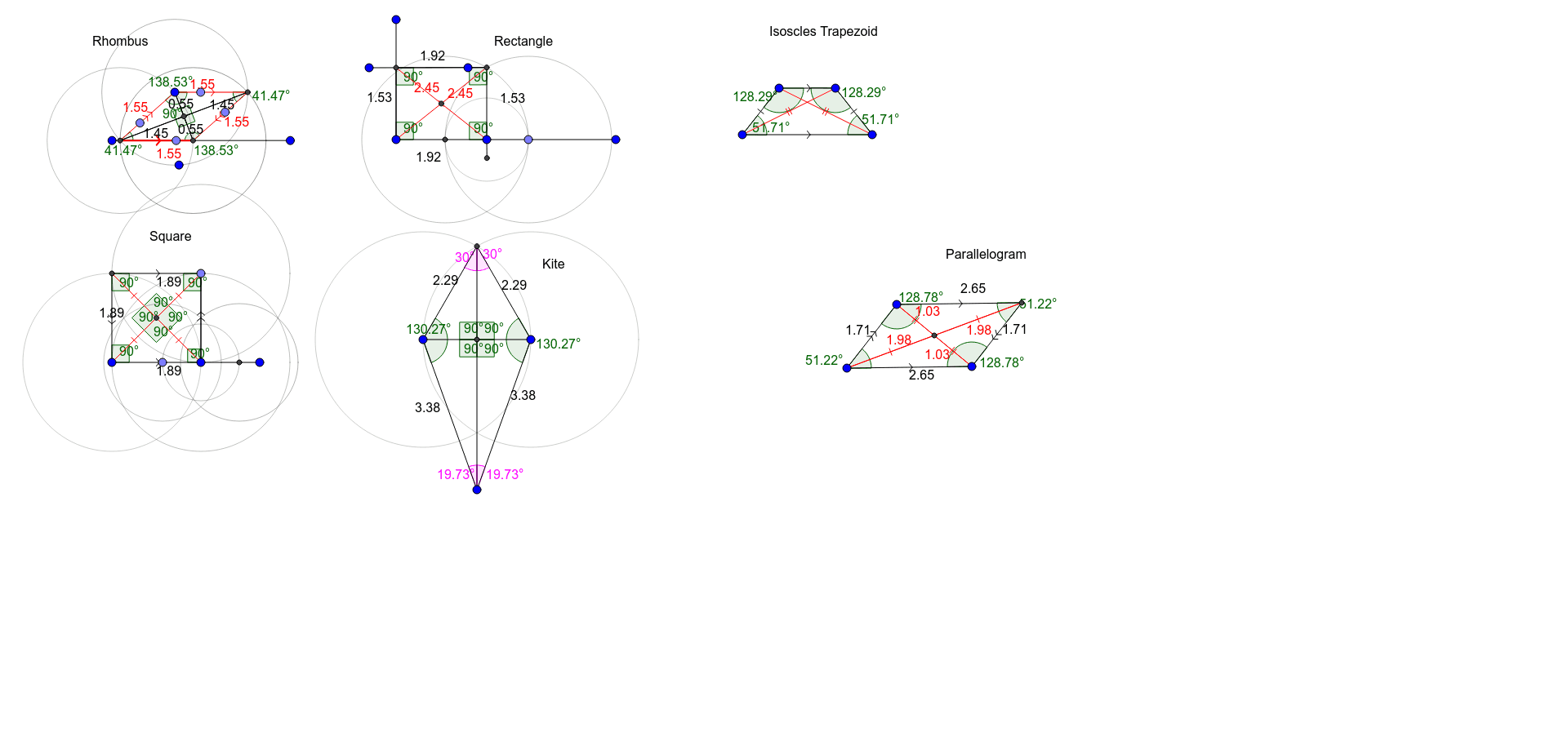
This example demonstrates methods for constructing quadrilaterals. Key mathematical concepts include geometric constructions, trigonometric functions, and transformations. Using GeoGebra commands such as Segment, Circle, and Intersect, various types of quadrilaterals can be constructed. Suitable for middle and high school students learning geometric constructions.
GeoGebra Commands & Parameters
Segment(A, B) → fCircle(C, Segment[C, D]) → cIntersect(c, f, 1) → ECircle(E, Segment[C, D]) → dIntersect(d, f, 1) → FCircle(F, Segment[C, D]) → eIntersect(c, e, 1) → GSegment(C, G) → gSegment(G, F) → hSegment(E, C) → iSegment(F, E) → jSegment(E, F) → kSegment(E, F) → lPoint(g) → HPoint(h) → IPoint(f) → JPoint(i) → KAngle(K, C, H) → αAngle(H, G, I) → βAngle(I, F, J) → γAngle(J, E, K) → δSegment(G, E) → mSegment(C, F) → nIntersect(m, n) → LAngle(C, L, E) → εAngle(F, L, G) → ζAngle(G, L, C) → ηAngle(E, L, F) → θSegment(L, E) → pSegment(L, G) → qSegment(F, L) → rSegment(C, L) → sSegment(M, N) → tSegment(N, O) → aPoint(t) → PCircle(N, Segment[N, P]) → c_1Intersect(c_1, a, 1) → QCircle(Q, Segment[N, O]) → d_1Circle(P, Segment[O, N]) → e_1Circle(M, Segment[M, N]) → f_1Circle(N, Segment[N, M]) → g_1Point(g_1) → SSegment(N, S) → h_1Circle(S, Segment[M, N]) → k_1Intersect(f_1, k_1, 1) → TSegment(T, S) → i_1Segment(T, M) → j_1Angle(T, S, N) → ιSegment(S, N) → l_1Angle(S, N, P) → κAngle(P, M, T) → λAngle(M, T, S) → μSegment(T, N) → bSegment(S, M) → m_1Intersect(b, m_1) → RAngle(T, R, M) → νAngle(M, R, N) → ξAngle(N, R, S) → οAngle(S, R, T) → ρSegment(T, R) → n_1Segment(R, N) → p_1Segment(S, R) → q_1Segment(R, M) → r_1Segment(U, V) → s_1Segment(U, W) → t_1Point(s_1) → ZCircle(U, Segment[Z, U]) → c_2Intersect(c_2, t_1, 1) → A_1Circle(Z, Segment[Z, A_1]) → d_2Circle(A_1, Segment[Z, A_1]) → e_2Intersect(d_2, e_2, 2) → B_1Segment(U, B_1) → a_1Segment(W, B_1) → b_1Segment(B_1, C_1) → f_2Segment(W, D_1) → g_2Intersect(f_2, g_2) → E_1Segment(W, E_1) → h_2Segment(E_1, B_1) → i_2Angle(U, W, E_1) → σAngle(B_1, U, W) → τRotate(W, 90°, E_1) → W'Angle(W, E_1, W') → υRotate(E_1, 90°, B_1) → F_1Angle(E_1, B_1, F_1) → ϕSegment(F_1, U) → j_2Segment(E_1, U) → k_2Intersect(b_1, k_2) → G_1Segment(H_1, I_1) → l_2Circle(I_1, Segment[H_1, I_1]) → p_2Circle(H_1, Segment[I_1, H_1]) → q_2Intersect(p_2, q_2, 2) → J_1Segment(J_1, K_1) → m_2Segment(J_1, H_1) → n_2Segment(H_1, K_1) → r_2Segment(J_1, I_1) → s_2Segment(I_1, K_1) → t_2Intersect(l_2, m_2) → L_1Angle(J_1, L_1, H_1) → χAngle(I_1, L_1, J_1) → ψAngle(K_1, L_1, I_1) → ωAngle(H_1, L_1, K_1) → α_1Angle(K_1, H_1, J_1) → β_1Angle(J_1, I_1, K_1) → γ_1Angle(L_1, K_1, H_1) → δ_1Angle(I_1, K_1, L_1) → ε_1Angle(H_1, J_1, L_1) → ζ_1Angle(L_1, J_1, I_1) → η_1Segment(M_1, N_1) → a_2Segment(O_1, P_1) → b_2Segment(P_1, N_1) → f_3Segment(O_1, M_1) → g_3Angle(M_1, O_1, P_1) → θ_1Angle(O_1, P_1, N_1) → ι_1Angle(N_1, M_1, O_1) → κ_1Angle(P_1, N_1, M_1) → λ_1Segment(O_1, N_1) → h_3Segment(M_1, P_1) → i_3Segment(Q_1, R_1) → j_3Line(S_1, j_3) → k_3Segment(Q_1, S_1) → l_3Line(R_1, l_3) → m_3Intersect(k_3, m_3) → T_1Segment(R_1, T_1) → n_3Segment(T_1, S_1) → p_3Angle(Q_1, R_1, T_1) → μ_1Angle(R_1, T_1, S_1) → ν_1Angle(T_1, S_1, Q_1) → ξ_1Angle(S_1, Q_1, R_1) → ο_1Segment(R_1, S_1) → q_3Segment(T_1, Q_1) → r_3Intersect(q_3, r_3) → U_1Segment(Q_1, U_1) → s_3Segment(U_1, T_1) → t_3Segment(R_1, U_1) → a_3Segment(U_1, S_1) → b_3
AI Drawing Prompt Reference
Construct a quadrilateral with points C and D as the endpoints of the diagonals. Use segments, circles, and intersections to determine the other vertices E, F, G, and H. Then, measure angles and connect segments to form the internal structure of the quadrilateral, including angles α, β, γ, and δ. Finally, use intersections of segments and circles to further refine the quadrilateral construction, ensuring all sides and angles meet geometric requirements.
The prompt above was compiled from the original drawing commands and is for reference only.